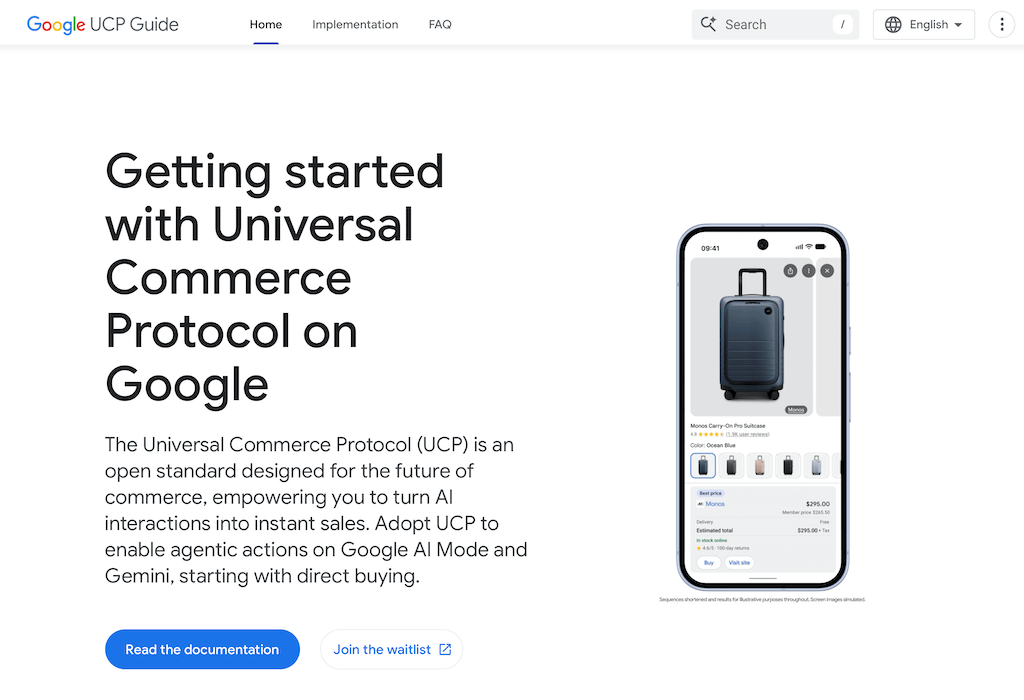
Google and Shopify present the Universal Commerce Protocol (UCP), an open framework for agentic commerce. From now on, AI agents such as Gemini and Microsoft Copilot will seamlessly connect shops, payment services, and loyalty programs to enable purchases directly from AI-supported interfaces.
UCP is an open, platform-independent standard developed by Google and Shopify with support from partners such as Etsy, Target, Wayfair, and more than 20 retail and payment players.
As a protocol, it enables universal exchange between AI agents and commerce systems —without individual integration and proprietary API connections. The focus is on features such as discounts, loyalty bonus points, subscriptions, and flexible payment flows.
Example: Search for sports shirts on Google.
In Google a user asks for sports shirts with neon designs in size S for under $30 with free delivery within the next 3 days.
Google searches numerous stores that support the UCP protocol, finds 10 matching offers, and displays them.
The user chooses one and instructs Google via chat to order the shirt.
After entering the delivery details, the shirt is ordered directly via chat.
Advantages: Instead of searching through numerous stores with various conditions, as was previously the case, the search and order can be done easily via chat. The entire process becomes much more convenient.
This is what the Universal Commerce Protocol looks like in action
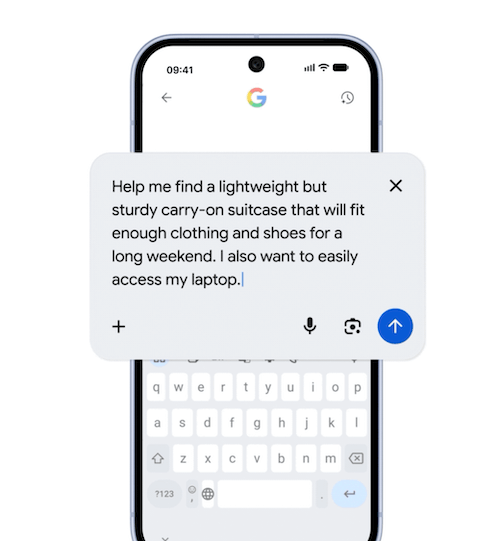
Google’s promo video illustrates the UCP in action: A suitcase is researched and ordered via chat.
Technical basis: Agent2Agent, Checkout State Machine, Payments Negotiation
The protocol relies on modern interfaces such as REST, GraphQL, JSON-RPC, Agent2Agent (A2A), Agent Payments Protocol (AP2), and Model Context Protocol (MCP).
The Checkout State Machine approach organizes the entire checkout process into structured states. If the AI agent automatically resolves all open issues, checkout becomes a one-click flow for users on Google Search or Gemini.
Payments Negotiation clarifies preferences and routing: Merchants specify accepted payment methods (e.g., Shop Pay, Google Pay, BNPL), while agent profiles automatically contribute matching credentials and preferences.
For merchants: control, data sovereignty, and new reach
The merchant remains the merchant of record and has full access to customer data and relationships. The UCP supports both native and embedded integration paths and feeds Google Merchant Center feeds directly into AI-driven shopping flows.
Modularity allows for custom features such as loyalty linking, multi-item carts, or returns processing.
Use cases & Shopify integration: Agentic storefronts & open ecosystem
Shopify uses UCP for Agentic Storefronts (Google, Microsoft Copilot) and for shopping via ChatGPT, among other things.
The open, license-free framework approach allows it to be used in a wide variety of ecosystems and positions UCP directly alongside solutions from OpenAI/Stripe.
One advantage: merchants can declare specific commerce capabilities—UCP automatically negotiates differences without individual prior coordination.
Transparency, traceability & future roadmap
UCP relies on transparent accountability trails and makes it possible to design processes in agentic commerce in a traceable manner. The roadmap includes additional features such as loyalty linking, multi-item carts, and integration of new full checkouts for the most important commerce platforms.
To provide the best experiences, we use technologies like cookies to store and/or access device information. Consenting to these technologies will allow us to process data such as browsing behavior or unique IDs on this site. Not consenting or withdrawing consent, may adversely affect certain features and functions.
Functional
Always active
The technical storage or access is strictly necessary for the legitimate purpose of enabling the use of a specific service explicitly requested by the subscriber or user, or for the sole purpose of carrying out the transmission of a communication over an electronic communications network.
Preferences
The technical storage or access is necessary for the legitimate purpose of storing preferences that are not requested by the subscriber or user.
Statistics
The technical storage or access that is used exclusively for statistical purposes.The technical storage or access that is used exclusively for anonymous statistical purposes. Without a subpoena, voluntary compliance on the part of your Internet Service Provider, or additional records from a third party, information stored or retrieved for this purpose alone cannot usually be used to identify you.
Marketing
The technical storage or access is required to create user profiles to send advertising, or to track the user on a website or across several websites for similar marketing purposes.