Google changes AI collaboration with Agent2Agent (A2A) protocol
Related to multiple guides. For full context, see our Google Gemini Guide & AI Agents Guide. How AI Rockstars evaluates this update AI Rockstars evaluates Google changes AI collaboration with…
FSFlorian SchröderUpdated Jun 26, 20265 min read Human reviewed
✓ ReviewedLast updated June 26, 2026 by Florian Schröder
AI Rockstars evaluates Google changes AI collaboration with Agent2Agent (A2A) protocol by checking official product information, availability, pricing or cost impact, workflow relevance, integration depth, and whether the update changes a practical decision for teams. This article should be read as an AI-news explainer: verify current access, terms, and model behavior before using the tool in production.
What should readers do next?
Use this post to understand the update, then compare it with the broader Google Gemini guide and the AI Rockstars planning tools. For business use, check whether the tool improves quality, saves time, reduces cost, or adds integration risk before rolling it into a workflow.
Agent2Agent protocol (A2A): Google establishes new standard for AI agent communication
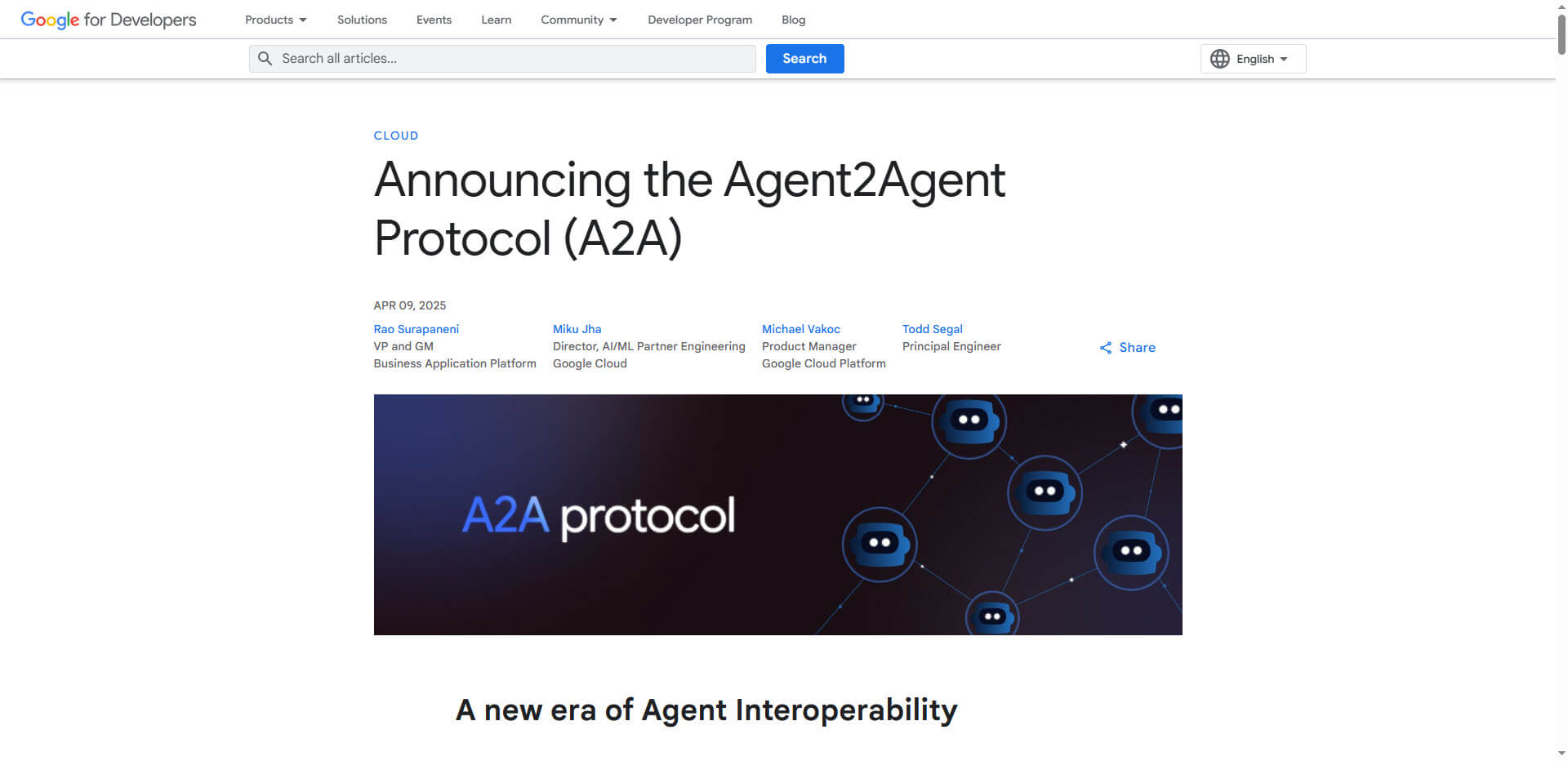
Google introduces the Agent2Agent (A2A) protocol, an open standard that revolutionizes collaboration between AI agents across platform and vendor boundaries. Developed in cooperation with over 50 technology partners such as Salesforce, SAP and Deloitte, A2A addresses the critical challenge of interoperability in multi-agent ecosystems and marks a fundamental shift towards vendor-independent AI environments.
The A2A protocol enables organizations to orchestrate complex workflows through autonomous agent collaboration, increasing productivity and reducing costs. The technical architecture is based on a client-server model in which agents can dynamically take on the role of client or contractor depending on the context. Using agent cards – JSON-based metadata – agents communicate their capabilities, authentication requirements and supported services.
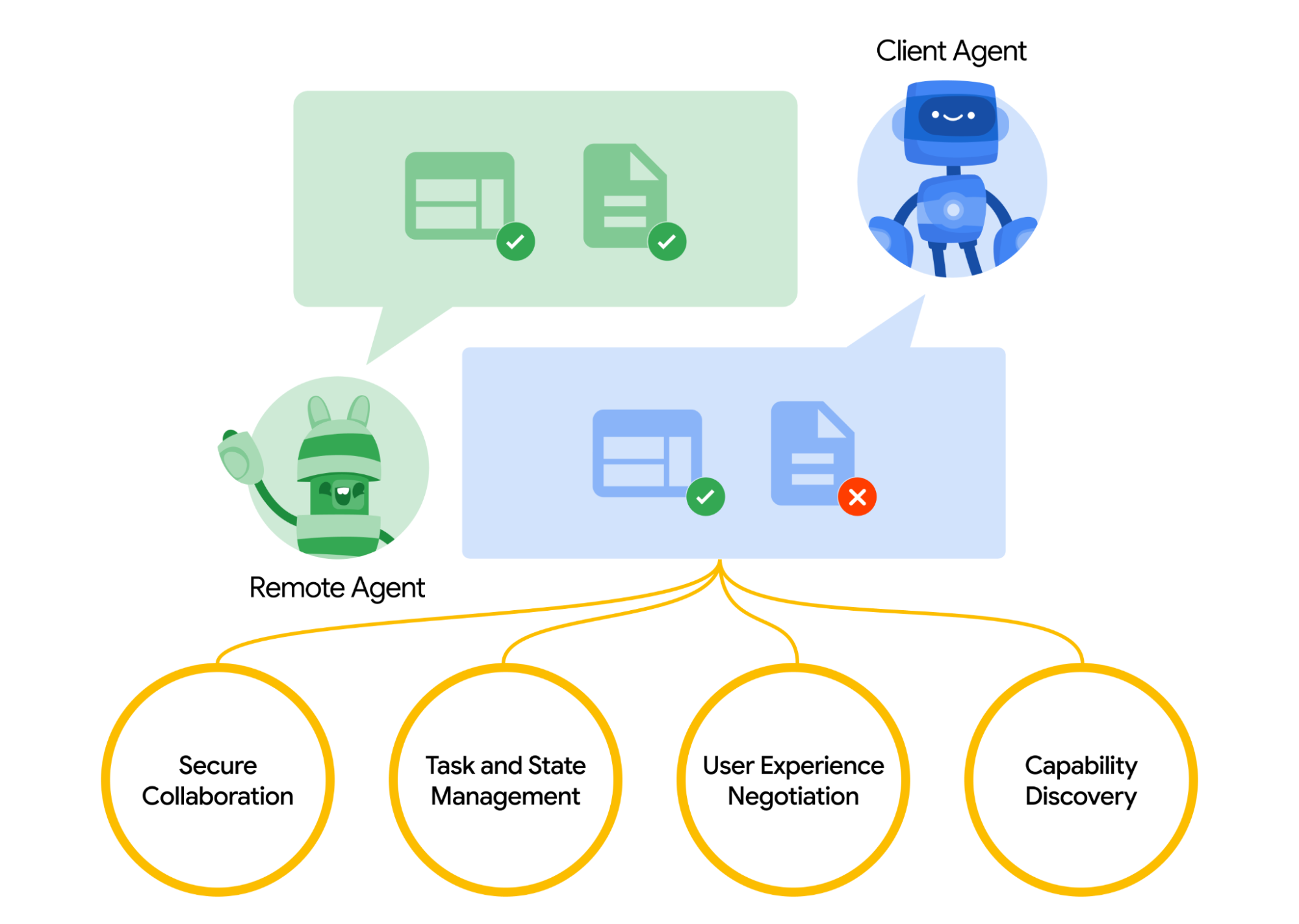
an illustrated flow chart showing the flow of data between the remote agent and the client agent to produce secure collaboration, task and state management, user experience negotiation, and capability discovery ; How A2A works ; source: developers.googleblog.com
The task lifecycle includes negotiation and execution phases, supporting both short-lived and long-term processes. By leveraging existing web standards such as HTTP, JSON-RPC and SSE, A2A ensures compatibility with legacy systems while integrating enterprise-grade security features such as OAuth 2.0 and mutual TLS for authentication.
The protocol respects opaque execution – agents retain full control over their internal decision-making processes and only share task-specific inputs and outputs. This prevents proprietary algorithms or sensitive data from being exposed across organizational boundaries. In addition, A2A is modality agnostic and supports text, audio/video streams, forms and embedded user interfaces for different interaction requirements.
A2A forms a central part of Google’s broader AI agent ecosystem, which includes the Gemini models, the Agent Development Kit (ADK), the AI Agent Marketplace and Agentspace. By positioning A2A as the link between these layers, Google aims to establish its cloud platform as the central hub for multi-agent ecosystems.
The early partnership with infrastructure providers (MongoDB), SaaS providers (Workday) and consulting firms (Accenture) ensures the cross-industry relevance of A2A. This interoperability reduces dependency on individual vendors and accelerates the ROI of AI investments by leveraging existing cloud services.
Key facts about the protocol
A2A was developed in collaboration with over 50 technology partners
The protocol enables seamless communication between AI agents from different providers
The technical basis is formed by established web standards (HTTP, JSON-RPC, SSE)
Agent cards are used to publish capabilities and services
A2A supports both short-lived and long-term task processes
Enterprise-grade security functions protect proprietary algorithms and sensitive data
Protocol is modality agnostic and supports text, audio/video and more
Integration with Google’s broader AI ecosystem creates a complete agent stack
A2A addresses the critical problem of interoperability in multi-agent scenarios
The open protocol is hosted on GitHub and made available for community contributions
TL;DR: Google Agent2Agent matters because agent interoperability is a core infrastructure topic. The page belongs in the AI agents cluster.
Editorial recommendation: Keep this page indexable as a supporting cluster asset, but refresh it when the underlying product or model changes materially.
Indexing decision
Factor
Decision
Why it matters
Search intent
Keep indexed
The topic supports a strategic AI Rockstars cluster.
Content role
Evergreen context
The post explains an important AI product, model, or workflow milestone.
Editorial handling
Review periodically
Refresh if product capabilities, pricing, or availability materially change.
FAQ
Why is Google Agent2Agent protocol relevant?
Google Agent2Agent protocol is relevant because it connects to multi-agent interoperability workflows, a recurring topic for AI professionals and teams.
Should teams use Google Agent2Agent protocol as a current buying guide?
Use the article as context and verify current product details, pricing, and availability before making decisions.
How should this topic be evaluated?
Evaluate it by workflow fit, reliability, integrations, cost, governance, and measurable business value.
Florian Schröder is a co-founder of AI Rockstars and an expert in AI strategies for marketing. He advises companies on integrating AI tools such as ChatGPT, Claude, and Gemini into their workflows. With over 10 years of experience in digital marketing, he combines technical expertise with practical applications.
To provide the best experiences, we use technologies like cookies to store and/or access device information. Consenting to these technologies will allow us to process data such as browsing behavior or unique IDs on this site. Not consenting or withdrawing consent, may adversely affect certain features and functions.
Functional
Always active
The technical storage or access is strictly necessary for the legitimate purpose of enabling the use of a specific service explicitly requested by the subscriber or user, or for the sole purpose of carrying out the transmission of a communication over an electronic communications network.
Preferences
The technical storage or access is necessary for the legitimate purpose of storing preferences that are not requested by the subscriber or user.
Statistics
The technical storage or access that is used exclusively for statistical purposes.The technical storage or access that is used exclusively for anonymous statistical purposes. Without a subpoena, voluntary compliance on the part of your Internet Service Provider, or additional records from a third party, information stored or retrieved for this purpose alone cannot usually be used to identify you.
Marketing
The technical storage or access is required to create user profiles to send advertising, or to track the user on a website or across several websites for similar marketing purposes.
 an illustrated flow chart showing the flow of data between the remote agent and the client agent to produce secure collaboration, task and state management, user experience negotiation, and capability discovery ; How A2A works ; source: developers.googleblog.com
The task lifecycle includes negotiation and execution phases, supporting both short-lived and long-term processes. By leveraging existing web standards such as HTTP, JSON-RPC and SSE, A2A ensures compatibility with legacy systems while integrating enterprise-grade security features such as OAuth 2.0 and mutual TLS for authentication.
The protocol respects opaque execution – agents retain full control over their internal decision-making processes and only share task-specific inputs and outputs. This prevents proprietary algorithms or sensitive data from being exposed across organizational boundaries. In addition, A2A is modality agnostic and supports text, audio/video streams, forms and embedded user interfaces for different interaction requirements.
an illustrated flow chart showing the flow of data between the remote agent and the client agent to produce secure collaboration, task and state management, user experience negotiation, and capability discovery ; How A2A works ; source: developers.googleblog.com
The task lifecycle includes negotiation and execution phases, supporting both short-lived and long-term processes. By leveraging existing web standards such as HTTP, JSON-RPC and SSE, A2A ensures compatibility with legacy systems while integrating enterprise-grade security features such as OAuth 2.0 and mutual TLS for authentication.
The protocol respects opaque execution – agents retain full control over their internal decision-making processes and only share task-specific inputs and outputs. This prevents proprietary algorithms or sensitive data from being exposed across organizational boundaries. In addition, A2A is modality agnostic and supports text, audio/video streams, forms and embedded user interfaces for different interaction requirements.