Related to multiple guides. For full context, see our ChatGPT Guide & AI Agents Guide.
How AI Rockstars evaluates this update
AI Rockstars evaluates OpenAI releases new tools for agent-based applications by checking official product information, availability, pricing or cost impact, workflow relevance, integration depth, and whether the update changes a practical decision for teams. This article should be read as an AI-news explainer: verify current access, terms, and model behavior before using the tool in production.
What should readers do next?
Use this post to understand the update, then compare it with the broader AI agents guide and the AI Rockstars planning tools. For business use, check whether the tool improves quality, saves time, reduces cost, or adds integration risk before rolling it into a workflow.
Which official sources should readers compare?
The most important facts about the update
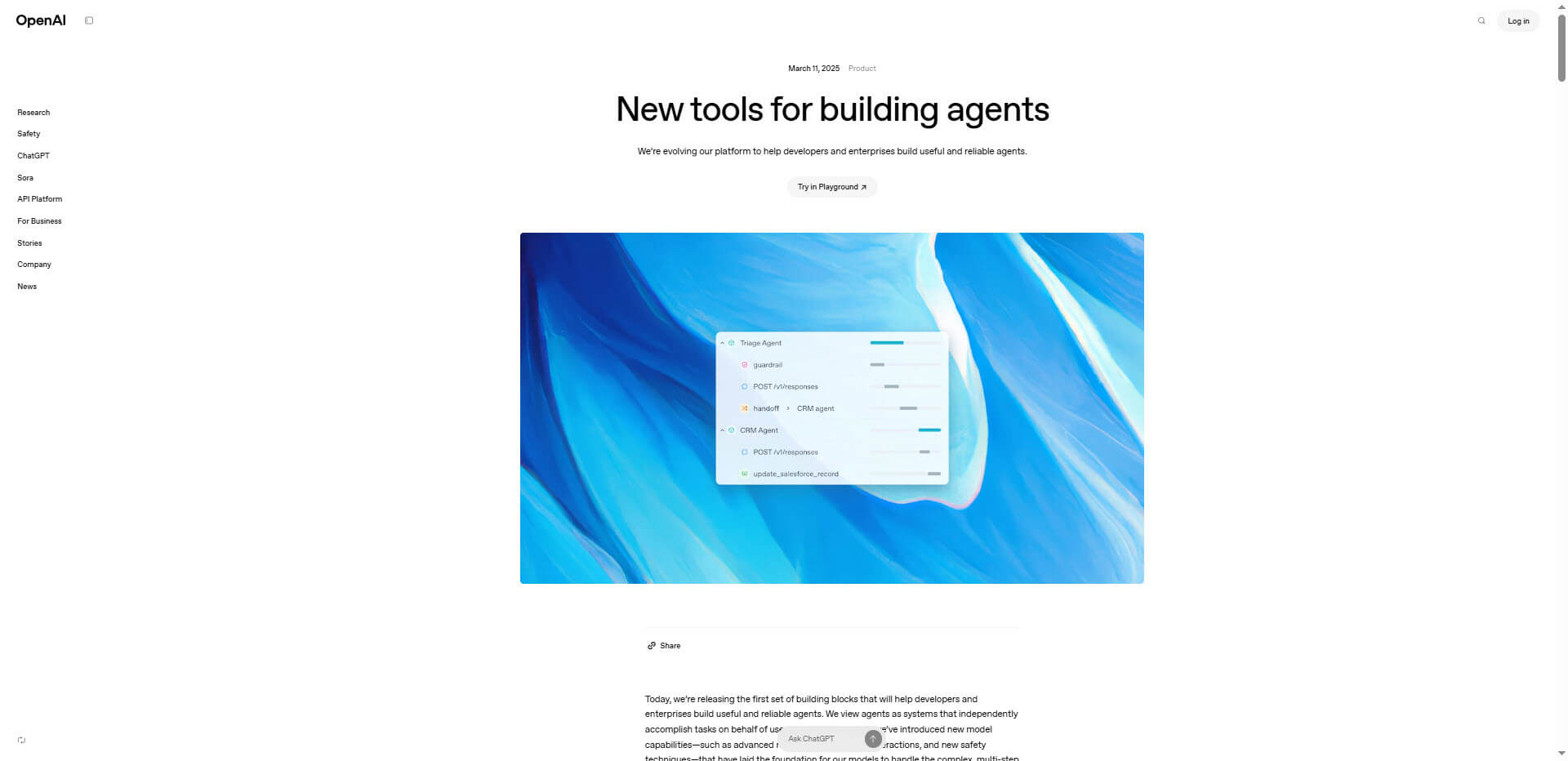
Among other things, OpenAI is introducing the new Responses API, which combines the flexibility of the Chat Completions API with the functionality of the Assistants API. For developers, this means a simpler and more efficient way to implement agent-based applications. In addition, there are built-in tools such as web and file search as well as browser automations that enable agents to handle complex tasks precisely and independently. Of particular note is the Agents SDK, an open-source tool that can orchestrate single-agent and multi-agent workflows, supported by integrated monitoring tools that make the agents’ workflows traceable. The strategic decision to focus on user-friendly tools addresses key challenges that developers often face. These include the optimization of prompts, the coordination of complex processes and, above all, the introduction of transparency in development work. With the new tools, OpenAI wants to make it easier to get started with agent-based AI and accelerate industrial adaptation.A step towards practical application
It is noteworthy that companies such as Hebbia and Coinbase are already successfully implementing the new tools, demonstrating early confidence in the capabilities of these technologies. The focus on practical applications is a deliberate move away from mere concept presentations at conferences towards market-ready solutions. With the announced replacement of the Assistants API by 2026, OpenAI is focusing on promising foundations and a long-term vision.Read also: GPT-5.3 Codex: The autonomous coding agent is here
However, the competition is not sleeping: Google’s Gemini and Anthropic’s Claude are also aiming to conquer the market for AI agents. This is creating an innovative competition in which companies and developers will ultimately have to assert themselves with highly customized solutions and cross-platform implementations.Necessity and risks of the new tools
While the tools promise considerable efficiency gains, they also harbor technical and ethical risks. Autonomous AI agents that carry out complex web searches or perform browser-based tasks automatically, for example, shift both responsibility and risks to the technological side. The further development of such tools therefore requires not only technological progress, but also regulations and mechanisms to ensure safety and accountability. However, the opportunities offered by innovations such as these cannot be denied. Companies can use autonomous AI agents to automate workflows and reduce costs while increasing the scalability of their processes. This move underlines the fact that 2023 is indeed the “year of the agent”, in which even many challenges will be openly discussed and tackled.Summary of the key points
- Responses API: Combines ease of use with powerful functionality for building agentic applications.
- Integrated tools: Enable web and file search and automated browser workflows.
- Agents SDK: Open developer kit for orchestrating single and multi-agent workflows.
- Competition: Other players such as Google and Anthropic are also launching their own AI agent platforms.
- Future prospects: OpenAI plans a gradual transition to the new systems by 2026; this shows clear confidence in the scalability and relevance of these technologies.
AI Rockstars verdict
TL;DR: OpenAI’s agent application tools are strategically relevant for developers building tool-using, multi-step AI systems.
Editorial recommendation: Keep this page indexable as a supporting cluster asset and refresh it after material product changes.
Indexing decision
| Factor | Decision | Why it matters |
|---|---|---|
| Cluster value | High | This page strengthens agent development and tool-use workflows. |
| Search intent | Technical or product research | The topic maps to a recognizable product, platform, model, or workflow. |
| Maintenance | Refresh on material changes | Keep capabilities, availability, and positioning current. |
FAQ
Why is OpenAI agent application tools relevant?
OpenAI agent application tools is relevant because it connects to agent development and tool-use workflows.
How should teams evaluate OpenAI agent application tools?
Evaluate workflow fit, output quality, integrations, reliability, cost, security, and governance.
Is the article a current buying guide?
Use it as strategic context and verify current product details, pricing, and availability before decisions.