ChatGPT Search: How It Works and What It Means for SEO
A practical explanation of ChatGPT Search, source citations, privacy considerations, and what publishers should do for AI search visibility.
FSFlorian SchröderUpdated Jun 26, 20268 min read Human reviewed
✓ ReviewedLast updated June 26, 2026 by Florian Schröder
BLUF: ChatGPT Search turns web search into a conversational workflow: ChatGPT can search automatically when fresh information is useful, show cited sources, and let users continue with follow-up questions. For publishers and companies, the key implication is clear: content must be crawlable, source-worthy, current, and easy for AI systems to quote.
AI Rockstars evaluates ChatGPT Search by looking at how answer engines select sources, extract passages, handle freshness, and combine web results with model-generated summaries. We test recommendations against practical search-intent patterns: definition queries, comparison queries, tool-selection queries, and business implementation questions. The article is structured to make core passages self-contained, source-aware, and easy for AI systems to cite without losing context.
TL;DR
ChatGPT Search is available in ChatGPT on web, desktop, and mobile apps, with access across Free, Plus, Team, Edu, and Enterprise plans where available.
Search can run automatically when a prompt needs current web information, or users can select Search manually.
Responses may include inline citations, a Sources panel, images, maps, and location-aware results depending on the query.
For AI visibility, allow relevant crawlers, publish clear source-backed pages, use strong internal linking, and keep high-value pages updated.
What is ChatGPT Search?
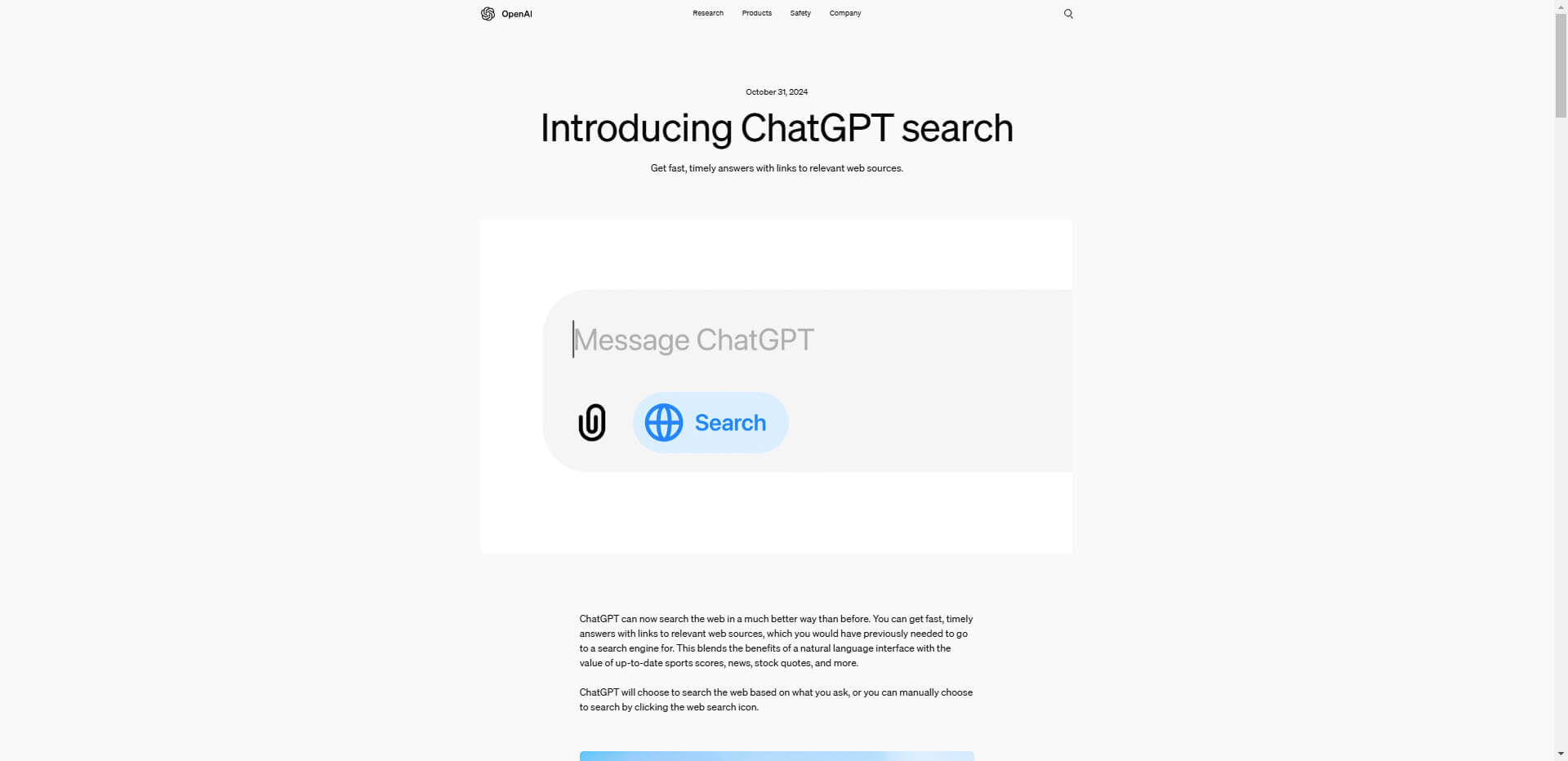
ChatGPT Search is OpenAI’s web search experience inside ChatGPT. It lets ChatGPT answer questions with current information from the web and provide links to relevant sources, instead of relying only on the model’s built-in knowledge.
OpenAI introduced ChatGPT Search on October 31, 2024 and later expanded access. OpenAI’s help center now describes availability across ChatGPT Free, Plus, Team, Edu, and Enterprise users, including logged-out Free access in supported regions. The feature is available through chatgpt.com and the ChatGPT desktop and mobile apps.
This matters because search behavior changes when users can ask follow-up questions instead of starting a new query each time. A user can ask for a current answer, inspect sources, refine the question, compare options, and continue the research thread inside one conversation.
How ChatGPT Search works
ChatGPT can decide to search the web when a question benefits from fresh or location-sensitive information. Users can also select the Search tool manually, use search shortcuts, or retry a response with web search when the first answer needs current context.
Search behavior
What it means
Why it matters
Automatic search
ChatGPT may search when current web information would improve the answer.
Publishers can be discovered during ordinary conversations, not only explicit search queries.
Manual search
Users can choose Search when they want fresh web results.
Users have a clearer research mode when accuracy and recency matter.
Source citations
Search answers may include inline citations and a source panel.
Pages need clear, quotable sections that deserve to be cited.
Location context
ChatGPT can use approximate or optional precise location depending on settings and query type.
Local and commerce content needs accurate entity, location, and availability signals.
Partner search queries
OpenAI says ChatGPT may rewrite prompts into targeted search queries sent to third-party providers.
Content should target natural questions, entities, and specific intent, not only exact-match keywords.
ChatGPT Search vs traditional Google search
ChatGPT Search does not replace every traditional search behavior. It is strongest when users want a synthesized answer, source links, and a conversational research path. Traditional search remains useful when users want a broad list of results, direct navigation, image-heavy browsing, local packs, shopping comparison, or a familiar SERP layout.
Dimension
ChatGPT Search
Traditional search
Interface
Conversational answer with follow-up context
Ranked result list, modules, and links
Best for
Summaries, explanations, comparisons, current answers, research workflows
Navigation, broad discovery, shopping, local exploration, visual browsing
Source visibility
Citations and Sources panel when available
Title, URL, snippet, rich result, and SERP features
User behavior
Users refine inside the same conversation
Users often reformulate separate searches
Publisher challenge
Be chosen as a cited source
Rank and earn clicks from result pages
What information is shared during ChatGPT Search?
OpenAI’s help center explains that ChatGPT Search can rewrite a user’s prompt into one or more targeted search queries. Those queries may be sent to third-party search providers. OpenAI says it does not share the user’s account information or IP address with those providers for the search request.
For location-based searches, ChatGPT can use general location information based on IP address. Users may optionally enable more precise device location in settings for more relevant local answers. This is especially relevant for restaurants, maps, weather, local recommendations, and other location-sensitive searches.
Why ChatGPT Search matters for SEO and GEO
ChatGPT Search makes answer quality and source quality more visible. A page is not only competing for a blue link. It is competing to become a cited input inside an AI-generated answer.
That changes the practical work. A strong page should answer the main question directly, make claims that can be verified, link to supporting sources, show a clear author or publisher, and connect to related pages through descriptive internal links. Thin rewritten news posts are weak candidates because they rarely add a reason to cite the site instead of the original source.
How to make a site more eligible for ChatGPT Search discovery
There is no guaranteed placement in ChatGPT Search. OpenAI says ranking depends on multiple factors designed to find reliable and relevant information. However, OpenAI specifically notes that sites should allow OAI-Searchbot and ensure the host or CDN permits traffic from OpenAI’s published IP addresses.
Allow AI search crawlers. Make sure important pages are not blocked by robots.txt, security tools, or CDN rules.
Publish source-worthy pages. Add original analysis, concise definitions, current dates, named sources, and practical examples.
Use clear schema. Article, Organization, Person, Breadcrumb, FAQ, HowTo, Product, or WebApplication schema should match the page type.
Strengthen topic clusters. Link pillar pages to supporting articles and tools using descriptive anchors.
Remove stale facts. Update product access, pricing, model names, screenshots, and availability claims when they change.
Make answers quotable. Lead sections with direct answers that can stand alone in an AI response.
Example: better structure for AI search visibility
A weak page about ChatGPT Search says only that OpenAI added web search and that it could challenge Google. A stronger page explains what the feature is, how it works, who can access it, what data may be shared, how citations appear, and what site owners should do next.
For AI visibility, the second version is better because it gives answer engines extractable units: a definition, process explanation, comparison table, privacy explanation, implementation checklist, and FAQ. That is the structure we also use across our ChatGPT guide, prompt engineering guide, and AI agents guide.
ChatGPT Search implications for publishers
Publishers should treat ChatGPT Search as an additional discovery surface. The goal is not only to rank, but to be useful enough to cite. That favors content with clear authorship, transparent sourcing, original data, concise answers, and a clean technical foundation.
It also raises the cost of low-quality content. Pages that only summarize an announcement without adding context have little citation value. Pages that explain implications, limitations, implementation steps, and verification methods have a better chance of being selected as useful sources.
AI Rockstars verdict
ChatGPT Search is important because it moves search from a result list into a conversational answer layer. For users, that can make research faster. For publishers and companies, it means source quality matters more than ever: the page has to be accessible, current, clearly structured, and worth citing.
For practical next steps, audit your crawl access, update thin AI news articles, strengthen internal links around key hubs, and add direct answer blocks to pages that should be cited by AI systems. Our free AI tools can also help evaluate automation readiness, ROI, and token costs for search-related AI workflows.
Yes, OpenAI’s help center describes ChatGPT Search as available to Free, Plus, Team, Edu, and Enterprise users in supported regions. Logged-out Free access is also described as available where ChatGPT is available.
Does ChatGPT Search show sources?
Yes. Search responses may include inline citations and a Sources panel with relevant links. Citation display can vary by query and interface, but source visibility is a central part of the search experience.
Can website owners guarantee visibility in ChatGPT Search?
No. OpenAI says there is no guaranteed top placement. Site owners should focus on crawl access, reliable content, strong source signals, and technical availability for relevant crawlers.
Is ChatGPT Search the same as SearchGPT?
No. SearchGPT was OpenAI’s prototype for AI search features. ChatGPT Search brought that search experience into ChatGPT for broader use.
Florian Schröder is a co-founder of AI Rockstars and an expert in AI strategies for marketing. He advises companies on integrating AI tools such as ChatGPT, Claude, and Gemini into their workflows. With over 10 years of experience in digital marketing, he combines technical expertise with practical applications.
To provide the best experiences, we use technologies like cookies to store and/or access device information. Consenting to these technologies will allow us to process data such as browsing behavior or unique IDs on this site. Not consenting or withdrawing consent, may adversely affect certain features and functions.
Functional
Always active
The technical storage or access is strictly necessary for the legitimate purpose of enabling the use of a specific service explicitly requested by the subscriber or user, or for the sole purpose of carrying out the transmission of a communication over an electronic communications network.
Preferences
The technical storage or access is necessary for the legitimate purpose of storing preferences that are not requested by the subscriber or user.
Statistics
The technical storage or access that is used exclusively for statistical purposes.The technical storage or access that is used exclusively for anonymous statistical purposes. Without a subpoena, voluntary compliance on the part of your Internet Service Provider, or additional records from a third party, information stored or retrieved for this purpose alone cannot usually be used to identify you.
Marketing
The technical storage or access is required to create user profiles to send advertising, or to track the user on a website or across several websites for similar marketing purposes.