These sources use LLMs for their responses — Findings from the 2026 blinq Study
An analysis of approximately 70,000 AI responses shows that ChatGPT, Google AI Overviews, and Perplexity do not randomly draw their sources from the web. More than half come from corporate…
RSRalf SchukayUpdated Jul 29, 20267 min read Human reviewed
✓ ReviewedLast updated July 29, 2026 by Ralf Schukay
An analysis of approximately 70,000 AI responses shows that ChatGPT, Google AI Overviews, and Perplexity do not randomly draw their sources from the web. More than half come from corporate websites—and if you want to appear in AI responses, you need to know where the models look.
Part of our ChatGPT Guide. For the full picture, see our complete ChatGPT Guide.
When a user asks ChatGPT about the best legal protection insurance or the right project management tool, the model doesn’t access the internet at random. There’s a recognizable pattern behind the selection of sources—and you can leverage that specifically to boost your own visibility. Welcome to the age of GEO (Generative Engine Optimization).
In February 2026, the company blinq analyzed approximately 70,000 responses from ChatGPT, Google AI Overviews, and Perplexity (see analysis) to determine which types of sources the models cite. The result is one of the largest public analyses to date on AI visibility in the German-speaking world. blinq founder Julian Gottke sums up the key message: Companies must be present “where AI gets its information.” So the pressing question is no longer just how to rank on Google—but whether the language models even consider your content worthy of citation. Good content must therefore be more well-researched than ever to become and remain visible to AI. Conclusion: These 5 source types dominate AI responses.
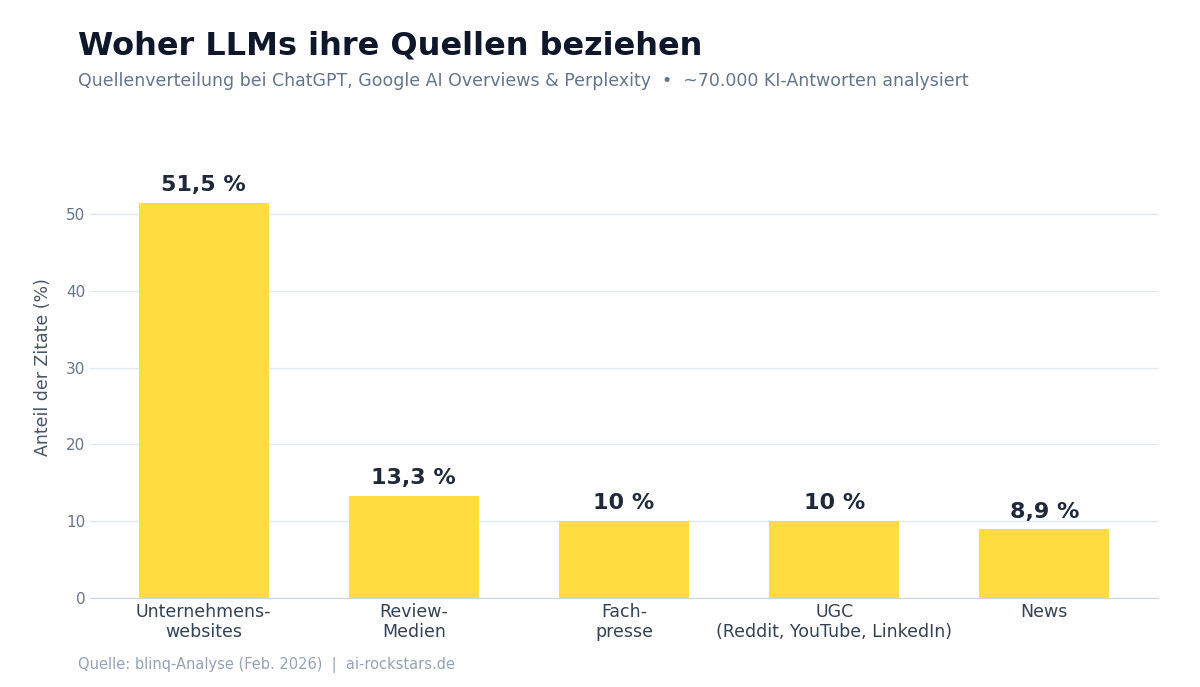
Source distribution in AI responses according to blinq analysis (approximately 70,000 LLM responses, February 2026).
Together, these sources account for approximately 93.7 percent of all citations—the remainder is split between rounding and uncategorized sources.
Examples: What typical sources and online media do AIs use for their responses?
If we break down the source types even further, it becomes clear exactly where AI systems get their information from. The table shows some examples of popular media sources that AI systems cite as trustworthy. An important note: Wikipediaand Wikidata are considered separate, overarching reference sources. They provide the semantic context that language models use to classify facts in the first place—an entry or a clean link there often indirectly impacts your overall AI visibility.
Source Type
Share
Typical Examples
Corporate Websites
51.5%
Company blogs, official manufacturer websites, landing pages
Review sites
13.3%
Kununu, Öko-Test, StepStone, Idealo, Test.de, and others
Trade press
10%
Chip (34.2% within the category), Utopia, Welt, Techradar, and others
UGC (User-Generated Content)
10%
Reddit (15.3%), YouTube (14.3%), LinkedIn (6.1%), and others
News
8.9%
Handelsblatt (5.7%), FAZ (4.2%), and others
Note: These five categories account for approximately 93.7 percent of all citations.
GEO: How to Increase Your Visibility in Key AI Sources
Knowing where AI systems get their answers is the key to becoming more visible there. In digital marketing, the most important strategies here are AI Optimization (AIO) and Generative Engine Optimization (GEO). Here are some of the most important levers for each AI source:
Corporate Websites (most effective lever):
Publish original content instead of paraphrased information (e.g., studies, comparisons, data, downloads, and more)
Use an FAQ format with direct answers
Keep support and FAQ pages up to date
Maintain Schema markup (JSON-LD) and XML sitemaps
Review media:
Actively ask for customer reviews
Create and maintain listings on relevant platforms
Respond to reviews
Implement structured review data (Schema.org) in the website code
Trade press:
Offer guest posts and expert interviews
Conduct digital PR
Aim for mentions in product comparisons and data surveys.
User-Generated Content:
Participate in relevant Reddit discussions with genuine user reviews
Regularly publish YouTube content
Post expert articles on LinkedIn
News:
Aim for mentions in reputable news outlets (impact is achieved even without a link)
Proactively provide up-to-date data to newsrooms
Especially important: Social media helps with AI visibility
An honest review in a relevant Reddit post or a well-made tutorial video can be more valuable for your AI visibility than your tenth blog post. According to the study’s authors, LLMs are increasingly treating websites as data sources—not just as destinations for clicks.
What this means for you in concrete terms
For businesses: Your own website remains the foundation. More than half of all AI citations come from corporate sites—that is, structured, up-to-date original content rather than thin SEO filler pages.
For marketers: GEO isn’t a replacement for SEO—it’s the next level. Think in terms of answers rather than keywords, and distribute your message across multiple types of sources.
For creators and developers: Reddit, YouTube, and LinkedIn are no longer just side channels. Those who consistently share expert knowledge there appear more often in AI responses.
By the way, monitoring these mentions can be automated: With a tool like n8n, you can build a workflow that collects new mentions of your brand on Reddit, in news feeds, or via Google Alerts and reports them to you in a consolidated format. We’ll show you how to measure AI traffic yourself in our guide to AI traffic tracking in GA4.
FAQ: AI Sources and Visibility
What is GEO (Generative Engine Optimization)?
GEO is the optimization of content so that AI response systems like ChatGPT, Perplexity, or Google AI Overviews classify it as trustworthy and cite it. GEO doesn’t replace traditional SEO; rather, it expands upon it by adding the dimension of AI visibility.
Which sources do LLMs cite most frequently?
According to the blinq analysis, 51.5 percent of all citations come from corporate websites—that is, company blogs and official manufacturer sites. This makes your own website the most important lever for AI visibility.
Why is Wikipedia so important for AI models?
Wikipedia and Wikidata provide the semantic context that language models use to classify facts and entities. A well-maintained entry helps the models correctly understand and categorize your brand.
Does a good Google ranking automatically lead to AI visibility?
No. A top ranking on Google is helpful, but it’s no guarantee of mentions in AI responses. LLMs also evaluate sources based on consistency, authority, and recency—and draw on UGC from Reddit or YouTube as well.
Sources and Further Reading
blinq: ChatGPT SEO – Original analysis of approximately 70,000 LLM responses and where AI sources its information.
onlinemarketing.de – Contextualizes the study within GEO techniques such as grounding pages and Common Crawl.
Meedia – Describes the transformation of the website “from a destination to a database.”
webAION – Guide to the hierarchy of source selection based on consistency, authority, and recency.
tba Berlin – How ChatGPT selects sources when conducting research.
analytics-agentur.ch – Original analysis on the targeted optimization of LLM visibility.
Conclusion: Be where the AI looks
The message of the blinq study is clear: AI visibility can be planned. Over half of all citations come from a company’s own website, and another third of the top sources come from social media. If you publish structured original content, actively manage reviews, and maintain a presence on Reddit, YouTube, and LinkedIn, you increase your chances of being mentioned in ChatGPT, Perplexity, and Google AI Overviews.
Traditional SEO remains the foundation—but the next level is GEO. A good starting point is to see which AI assistants your target audience actually uses. Get started today: Take a close look at your most important product page and make it the best answer to your customers’ questions.
Ralf Schukay is a co-founder of AI Rockstars and specializes in AI automation and enterprise solutions. He tests and compares AI tools for professional use and helps teams become more productive through workflow automation.
To provide the best experiences, we use technologies like cookies to store and/or access device information. Consenting to these technologies will allow us to process data such as browsing behavior or unique IDs on this site. Not consenting or withdrawing consent, may adversely affect certain features and functions.
Functional
Always active
The technical storage or access is strictly necessary for the legitimate purpose of enabling the use of a specific service explicitly requested by the subscriber or user, or for the sole purpose of carrying out the transmission of a communication over an electronic communications network.
Preferences
The technical storage or access is necessary for the legitimate purpose of storing preferences that are not requested by the subscriber or user.
Statistics
The technical storage or access that is used exclusively for statistical purposes.The technical storage or access that is used exclusively for anonymous statistical purposes. Without a subpoena, voluntary compliance on the part of your Internet Service Provider, or additional records from a third party, information stored or retrieved for this purpose alone cannot usually be used to identify you.
Marketing
The technical storage or access is required to create user profiles to send advertising, or to track the user on a website or across several websites for similar marketing purposes.