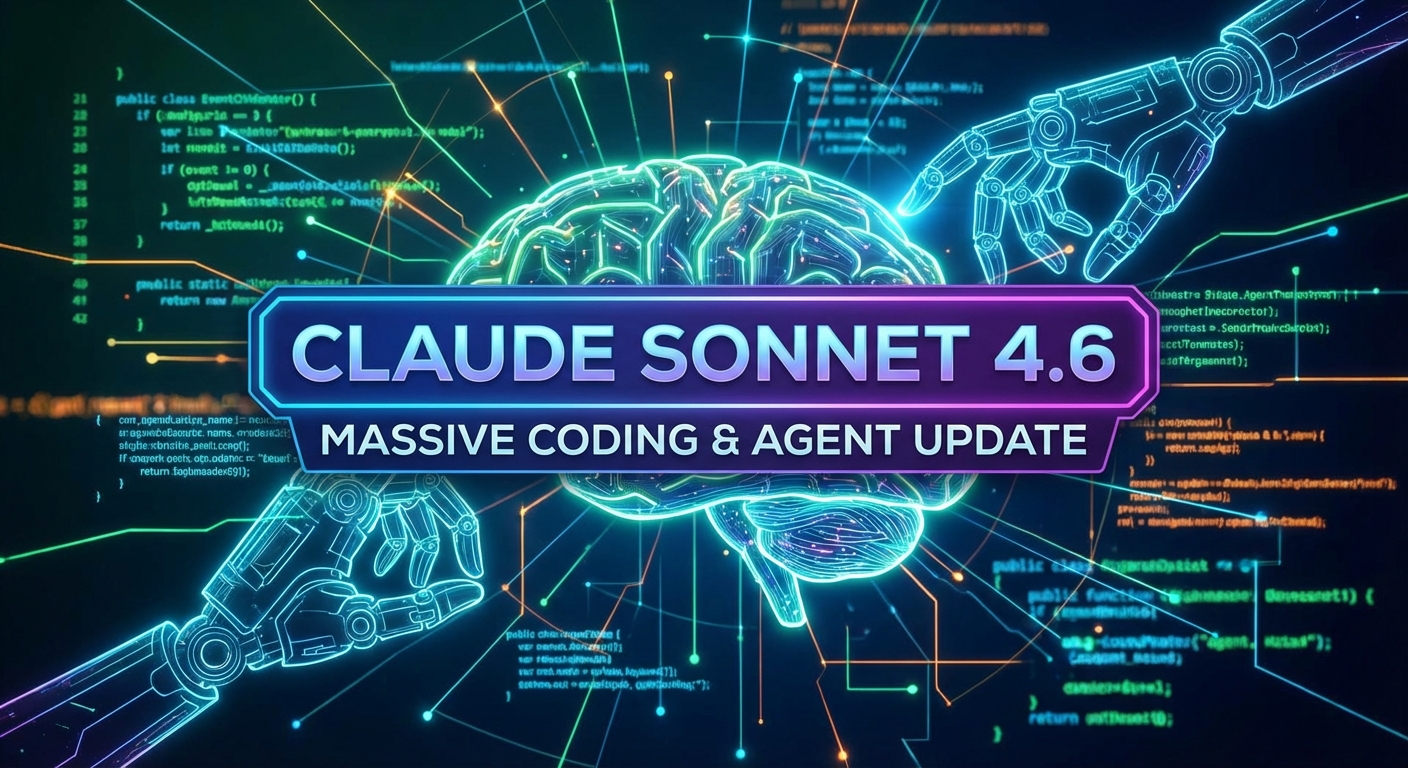
With the release of Claude Sonnet 4.6, Anthropic is setting new standards for AI agents and coding performance. As Anthropic announced in a recent blog post, the update is specifically aimed at developers and companies looking for automation beyond pure text generation. The model breaks with the previous hierarchy by technically surpassing its own high-end model, but remaining in the mid-range in terms of price.
The central feature is the next evolutionary stage of “computer use.” Claude Sonnet 4.6 is capable of operating software not only via code, but also directly via the graphical user interface (GUI) at an almost human level. The model navigates spreadsheets, operates web forms, and interacts with desktop applications. This allows Anthropic to avoid the need for complex API integrations.
Anthropic is upgrading its technology significantly to enable stable agent systems:
1 million token context window: Developers can process huge amounts of data, entire codebases, or long histories in a single prompt.
Context compaction & memory: New mechanisms ensure that relevant information is not forgotten, even over long periods of time (“memory tools”).
Performance leap: In relevant coding and reasoning benchmarks, Sonnet 4.6 outperforms the previous flagship Opus 4.5.
Price efficiency: Despite the performance increase, the model remains at $3 (input) and $15 (output) per 1 million tokens.
Why this is important
This update is more than just a version number; it is a strategic attack on the limitations
of
current AI agents
.
The ability to control software via GUI is the key to automating legacy systems that do not have APIs.
Until now
,
many agent workflows have failed due to interface issues. Claude Sonnet 4.6 closes this gap. For developers, the 1 million token context window, combined with the new memory functions, means that AI systems now have real “working memories” and can solve complex tasks autonomously over longer periods of time instead of hallucinating and losing track.
The fact that Anthropic offers this flagship performance at a mid-range price puts enormous pressure on the competition (OpenAI, Google). For many use cases, it eliminates the trade-off between intelligence and cost.
Availability & Conclusion
Claude Sonnet 4.6 is now available via the Anthropic API and in the web interface for subscribers. Prices are $3/$15 per 1M tokens. With this release, Anthropic currently offers the most attractive overall package for coding and agent development, making specialized high-cost models increasingly obsolete.
Claude Sonnet 4.6 vs Competitors: Head-to-Head Comparison
\n
How does Claude Sonnet 4.6 stack up against the most popular alternatives? The table below compares the key technical and pricing specs across the models developers and businesses are currently evaluating.
\n\n
\n
\n
\n
\n
Feature
\n
Claude Sonnet 4.6
\n
GPT-4o
\n
Gemini 1.5 Flash
\n
\n
\n
\n
\n
Input price (per 1M tokens)
\n
$3.00
\n
$5.00
\n
$0.075
\n
\n
\n
Output price (per 1M tokens)
\n
$15.00
\n
$15.00
\n
$0.30
\n
\n
\n
Context window
\n
1,000,000 tokens
\n
128,000 tokens
\n
1,000,000 tokens
\n
\n
\n
SWE-bench Verified score
\n
64.4%
\n
~49%
\n
Not publicly reported
\n
\n
\n
Extended / deep thinking mode
\n
Yes
\n
Yes (o-series only)
\n
Yes (Flash Thinking)
\n
\n
\n
Computer Use
\n
Yes (beta)
\n
No
\n
No
\n
\n
\n
Key strength
\n
Coding, agentic tasks, long-context reasoning
\n
Broad general use, multimodal
\n
Speed and cost efficiency
\n
\n
\n
\n
\n
Pricing as of March 2026. Always verify current rates on each provider’s official pricing page.
\n\n\n
Key Features of Claude Sonnet 4.6
\n
Claude Sonnet 4.6 is not a minor incremental update — it introduces several capabilities that meaningfully change what developers and power users can accomplish. Here is a closer look at what matters most.
\n\n
Extended Thinking Mode
\n
Extended Thinking allows Claude Sonnet 4.6 to spend additional inference compute \”thinking through\” a problem before producing a final answer. Anthropic exposes this chain-of-thought reasoning to the user as a visible thought block, giving teams insight into how conclusions are reached. This is particularly valuable for multi-step math, complex coding tasks, and ambiguous instructions where a single-pass response would fall short. Developers can control the thinking budget (in tokens) to balance depth against latency and cost.
\n\n
64.4% on SWE-bench — Coding Benchmark Leader
\n
SWE-bench Verified is widely regarded as the most demanding real-world coding benchmark available. It presents models with actual GitHub issues from popular open-source repositories and measures whether they can produce a patch that passes all unit tests. Claude Sonnet 4.6’s 64.4% score places it ahead of every other publicly available model at its price point. For software teams evaluating AI pair-programmers or autonomous coding agents, this number has a direct translation to fewer failed builds and less manual review.
\n\n
1 Million Token Context Window
\n
With a 1-million-token context window, Claude Sonnet 4.6 can ingest entire codebases, lengthy legal documents, hours of transcripts, or large datasets in a single prompt. Where GPT-4o is capped at 128k tokens — enough for roughly 100 pages of text — Sonnet 4.6’s context window holds the equivalent of a small novel or a mid-sized software project. This makes it uniquely suited for tasks like full-repo code review, document summarisation at scale, and long-horizon agent workflows that accumulate large amounts of history.
\n\n
Computer Use Capability
\n
Claude Sonnet 4.6 supports Anthropic’s Computer Use feature (currently in public beta), which enables the model to control a desktop environment — moving a cursor, clicking buttons, typing into fields, and reading what appears on screen. This opens the door to true UI automation without the need for custom scripting or dedicated RPA tools. Early enterprise adopters are using it for QA automation, form-filling workflows, and assisted data entry. As with all agentic features, Anthropic recommends pairing Computer Use with human oversight and well-scoped permission boundaries.
\n\n
MCP (Model Context Protocol) Support
\n
The Model Context Protocol is Anthropic’s open standard for connecting AI models to external tools and data sources in a structured, composable way. Claude Sonnet 4.6 has first-class MCP support, which means it integrates cleanly into MCP-compatible toolchains — from local development environments to cloud-based orchestration platforms. Instead of writing one-off tool-calling glue code for every integration, teams can define MCP servers once and expose them to any MCP-aware model. This dramatically reduces the overhead of building and maintaining agentic applications. Learn more about how Claude fits into modern AI stacks on our Claude hub page.
\n\n\n
\n
\”Claude Sonnet 4.6 has fundamentally shifted how I recommend teams approach AI-assisted development. The combination of Extended Thinking and a million-token context window means you can finally feed the model your entire codebase, ask it to reason through a refactor, and trust that it has the full picture — not just a fragment. The SWE-bench numbers are not marketing; in daily use, the model catches bugs and writes idiomatic code in a way that genuinely reduces review cycles. For any team building agentic workflows in 2026, Sonnet 4.6 should be the starting point.\”
\n
\n
\n\n\n
How to Get Started with Claude Sonnet 4.6
\n
Getting up and running with Claude Sonnet 4.6 is straightforward whether you are an individual developer, a startup, or an enterprise team. Follow these five steps to go from zero to your first working integration.
\n\n
\n
\n Create an Anthropic account and generate an API key. \n Go to console.anthropic.com, sign up or log in, navigate to \”API Keys,\” and create a new key. Store it securely — treat it like a password and never commit it to source control.\n
\n
\n Choose your access method. \n You can call the model directly via the Anthropic API, or through Amazon Bedrock (model ID: anthropic.claude-sonnet-4-6) or Google Cloud Vertex AI if your infrastructure already lives in those ecosystems. The Bedrock and Vertex routes simplify IAM, compliance, and billing for enterprise teams.\n
\n
\n Install the official SDK and send your first request. \n Anthropic publishes SDKs for Python (pip install anthropic) and TypeScript/Node (npm install @anthropic-ai/sdk). Instantiate the client, set the model to claude-sonnet-4-6-20250514, and send a simple messages request to verify connectivity before building anything complex.\n
\n
\n Experiment with Extended Thinking for complex tasks. \n Add \"thinking\": {\"type\": \"enabled\", \"budget_tokens\": 10000} to your API request parameters to activate Extended Thinking mode. Start with a budget of 5,000–10,000 tokens and adjust up or down based on the complexity of your prompts and your latency requirements.\n
\n
\n Explore the model in Claude.ai before going to production. \n If you want a no-code way to evaluate the model’s capabilities, Claude.ai (Pro or Team plan) gives you access to Sonnet 4.6 through the chat interface, including Projects (persistent memory) and file uploads. Use this to prototype prompts, test edge cases, and build intuition before committing engineering time to a full API integration.\n
\n
\n\n\n
Frequently Asked Questions About Claude Sonnet 4.6
\n\n
\n
Is Claude Sonnet 4.6 free?
\n
Claude Sonnet 4.6 is not free, but it is accessible at low cost. Via the Anthropic API, it is priced at $3.00 per million input tokens and $15.00 per million output tokens. A limited amount of Sonnet access is available through the free tier of Claude.ai, though free users may be throttled during peak hours. Claude Pro subscribers ($20/month) get priority access without rate-limit interruptions. For developers, the API offers a free trial credit to get started.
\n
\n\n
\n
What is Claude Sonnet 4.6’s context window?
\n
Claude Sonnet 4.6 has a context window of 1 million tokens — one of the largest available among general-purpose commercial models. In practical terms, this means the model can process roughly 750,000 words, or approximately 10,000 lines of code, in a single prompt. This makes it well-suited for tasks like ingesting entire codebases for review, summarising very long documents, or running long-horizon agent workflows that accumulate extensive conversation history.
\n
\n\n
\n
How does Claude Sonnet 4.6 compare to GPT-4o for coding?
\n
Claude Sonnet 4.6 outperforms GPT-4o on coding tasks by a significant margin. On SWE-bench Verified — the industry’s most rigorous real-world coding benchmark — Sonnet 4.6 scores 64.4% compared to GPT-4o’s approximately 49%. Beyond benchmark numbers, Sonnet 4.6 also offers a much larger context window (1M vs 128k tokens) and Extended Thinking mode, both of which are highly relevant for software development scenarios. For teams that prioritise coding quality, Sonnet 4.6 is the stronger choice at a comparable or lower price point.
\n
\n\n
\n
What is Extended Thinking in Claude?
\n
Extended Thinking is a feature in Claude Sonnet 4.6 (and Claude Opus) that lets the model allocate extra computation to reason through a problem step-by-step before generating its final response. Unlike standard chain-of-thought prompting, the thinking process is handled natively by the model and returned to the user as a separate, visible thought block via the API. You can set a token budget for the thinking process, giving you direct control over the trade-off between answer quality, latency, and cost. It is most impactful for multi-step reasoning, difficult coding problems, and complex analytical tasks.
To provide the best experiences, we use technologies like cookies to store and/or access device information. Consenting to these technologies will allow us to process data such as browsing behavior or unique IDs on this site. Not consenting or withdrawing consent, may adversely affect certain features and functions.
Functional
Always active
The technical storage or access is strictly necessary for the legitimate purpose of enabling the use of a specific service explicitly requested by the subscriber or user, or for the sole purpose of carrying out the transmission of a communication over an electronic communications network.
Preferences
The technical storage or access is necessary for the legitimate purpose of storing preferences that are not requested by the subscriber or user.
Statistics
The technical storage or access that is used exclusively for statistical purposes.The technical storage or access that is used exclusively for anonymous statistical purposes. Without a subpoena, voluntary compliance on the part of your Internet Service Provider, or additional records from a third party, information stored or retrieved for this purpose alone cannot usually be used to identify you.
Marketing
The technical storage or access is required to create user profiles to send advertising, or to track the user on a website or across several websites for similar marketing purposes.