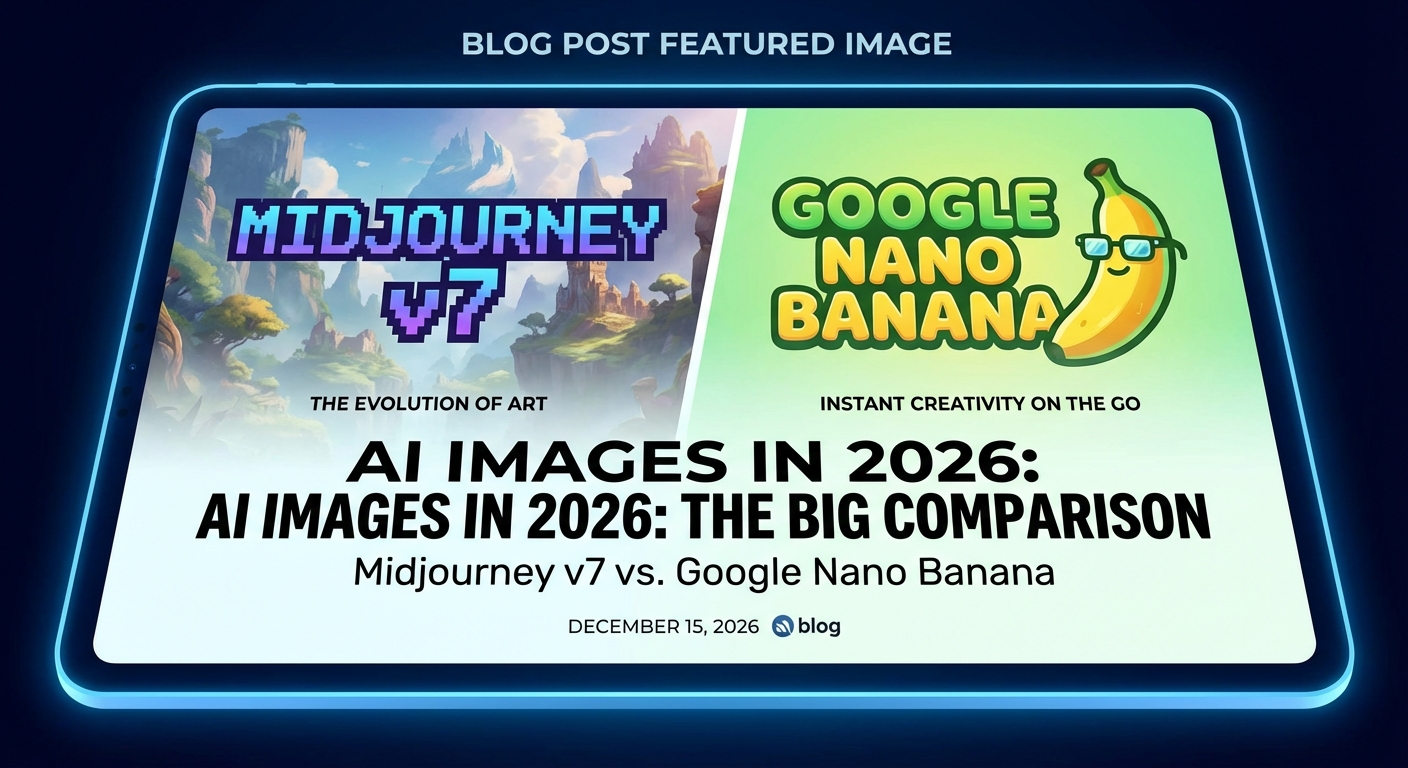
With the release of Gemini 2.5—known in the scene as “Nano Banana”—Google is launching a frontal attack on Midjourney v7’s artistic supremacy. While Midjourney remains the aesthetic benchmark, Google’s model now delivers perfect text in images and generates assets in a record-breaking two seconds. We analyze in detail whether raw utility speed ultimately triumphs over “artistic soul.”
Speed benchmark: Google Gemini 2.5 delivers results in under 2 seconds (Flash Mode), while Midjourney v7 takes approximately 22 seconds in standard mode.
Cost efficiency: Instead of Midjourney’s subscription costs (up to $120/month), Google enables scalable workflows via API for only $0.05 per image.
Technical architecture: Google uses a multimodal transformer for perfect text rendering (e.g., “SALE 2026”), while Midjourney, as a classic diffusion model, often fails with characters.
Mass processing: For e-commerce managers, Google’s API generates 100 images in under 1 minute, whereas Midjourney remains focused on a manual single-image workflow.
This reveals a fundamental split in the ecosystem in early 2026. While in 2024 all models were still trying to be “everything for everyone,” the market leaders have now diversified into completely different philosophies. It is no longer a race for the same goal, but a division of territory.
Google’s strategy with Gemini 2.5 Flash Image (community nickname: “Nano Banana”) is not aimed at replacing the artist, but the process. The model positions itself as a highly scalable tool for the mass market, where function takes precedence over emotion.
Utility first: Instead of artistic freedom, Google offers brutal prompt adherence. If an e-commerce manager orders a “sneaker on neon-wet asphalt,” Google delivers exactly that—without unwanted interpretations.
Multimodal understanding: The killer feature here is visual problem solving. You can show Gemini a photo of a broken bicycle and instruct it to “show me what it looks like when it’s repaired.” The model understands the context and generates the solution. This is no longer pure text-to-image, but logical image processing.
Target audience: Coders, social media managers for e-commerce, and editors who need thousands of assets automatically and consistently.
Midjourney: The stronghold of “high-end aesthetics”
Midjourney v7 has deliberately opted against sterile precision and defends the niche of artistic emotionality. Despite criticism of its declining “soul” compared to v6, v7 remains the gold standard for anything that needs to create a “wow effect.”
Vibe over Precision: Midjourney often sacrifices the exact spatial placement of objects for a more coherent overall look (lighting, composition, texture). It is not a tool for technical drawings, but for mood boards.
The Netflix factor: Those who need a pitch deck for a series or high-resolution cover art accept the more cumbersome workflow of v7 because the result looks less like a “corporate art generator” than Google.
Target audience: Storyboarders, concept artists, and designers who value atmosphere over photorealistic logic.
Strategic split in comparison (Q1 2026)
Feature
Google (Nano Banana)
Midjourney v7
Philosophy
Utility:Replace Photoshop & stock photos
Artistry:Replace the oil painter & illustrator
Analogy
High-speed printing
Digital studio
Strength
Context understanding & text rendering
Lighting & vibe
Weakness
Often appears sterile & soulless
Workflow hurdles & censorship filters
Primary use case
Programmatic mass creation (API)
Single-image artwork & pitches
Conclusion from practical experience: Anyone building a marketing dashboard in 2026 will integrate Google’s API. Anyone designing artwork for a fantasy book will use Midjourney. The days when one tool served both worlds are over.
Tech shootout: Midjourney v7 vs. “Nano Banana” (Gemini 2.5)
At the beginning of 2026, two technological philosophies stand irreconcilably opposed: the aesthetic precision of Midjourney and the raw utility power of Google. While Midjourney v7 is based on a highly specialized, proprietary diffusion model, Google’s Gemini 2.5 Flash Image Model (community nickname “Nano Banana”) relies on a multimodal transformer that is natively integrated into the LLM.
The result is a dramatic difference in latency: Midjourney takes around 22 seconds per image in normal “Fast Mode.” Even in reduced “Draft Mode,” it takes about 4 seconds. Google’s Flash Mode, on the other hand, delivers results in under 2 seconds – effectively real time.
Hard specs in direct comparison
Here are the key technical data of the current market leaders (as of Q1 2026):
Feature
Midjourney v7
Google “Nano Banana” (Gemini 2.5)
Architecture
Diffusion model (focus on texture/light)
Multimodal Transformer (Native LLM Integration)
Speed
~22s (standard), ~4s (draft)
< 2 seconds(Flash Mode)
Resolution
Upscale to 4K possible
Native 1024×1024 (Flash), up to 2048px (Pro)
Text rendering
Improved, but prone to errors
Perfectly legible(in-image text)
Access
Web interface & Discord
Vertex AI & API (programmatic)
Cost
Subscription model ($10 – $120/month)
Pay-per-use ($0.05 / image)
Feature focus: Aesthetics vs. utility
The target group separation is most evident in the features.
Midjourney v7 (The Artist): Its strength lies in “Omni Reference. “ This feature ensures character consistency across multiple images by saving faces and style elements (“Personalization”). The focus is on microscopic control of textures and lighting moods – ideal for high-end artwork where time is not an issue.
Google Gemini 2.5 (The Tool): The killer feature is in-image text rendering. While diffusion models often fail with lettering, Gemini generates error-free text (e.g., on signs or labels) directly in the image. In addition, the architecture enables multi-turn editing: you can make changes to the image via chat (“Make the sky blue”) without destroying the rest of the composition.
The cost trap: subscription vs. API
For companies, pricing is the decisive factor for scaling.
Midjourney: Relies on classic SaaS subscriptions. A professional user pays up to $120 per month for the “Mega” plan. There is hardly any official API for mass integration, which often forces companies to use gray third-party solutions.
Google: Offers an aggressive pay-per-use model via Vertex AI. At $0.05 per image in Flash Mode and $0.24 in Pro Mode, the barrier to automated workflows is extremely low. For those who need to generate thousands of assets for e-commerce, the Google API is mathematically cheaper and more stable than manual MJ seats.
Practical guide: Automation code vs. creative editor workflow
The deepest divide between the two luminaries is not in image quality, but in integration. While Google relies on scalable pipelines for developers, Midjourney optimizes the manual loop for art directors.
Here is a direct workflow comparison for practical use in 2026:
Feature
Google “Nano Banana” (API)
Midjourney v7 (Web Editor)
Target
Developers, e-commerce managers, app builders
Designers, concept artists, storytellers
Interface
Python / REST API
Web UI (Canvas) & Discord
Core strength
Batch processing(100 images in <1 min)
Granular control(inpainting, zoom)
Text rendering
Native (“SALE 2026” perfectly legible)
Room for improvement, often “gibberish”
Google “Nano Banana”: Mass production via Python
For e-commerce platforms or dynamic marketing campaigns, the Gemini 2.5 Flash Image Endpoint (community code: “Nano Banana”) is unbeatable. The use case: You need 100 product variations with correct text labeling without hiring a graphic designer.
Thanks to first-class optical character recognition (OCR) and rendering capabilities, the model writes text such as “SALE 2026” error-free directly into the neon sign in the image. The following 5-line stack generates a finished marketing asset in less than 3 seconds:
import google.genai as genai
from PIL import Image
import io

# Initialization (API key required)
client = genai.Client(api_key="YOUR_API_KEY")

# Prompt: Note the explicit text request
prompt = "A futuristic sneaker on neon-wet asphalt, side view. In the background, neon sign with the text 'SALE 2026'. Photorealistic, 8k."

response = client.models.generate_content(
    model="gemini-2.5-flash-image",
    contents=[prompt],
    config={
        "response_modalities": ["IMAGE"],
        "aspect_ratio": "16:9" # Native support without cropping
})


# Save the asset
for part in response.parts:
    if part.inline_data:
        image = Image.open(io.BytesIO(part.inline_data.data))
        image.save("sneaker_campaign_2026.png")
        print("Asset generated: sneaker_campaign_2026.png")
Midjourney v7: The manual “art director” workflow
If you’re not looking for mass-produced goods, but rather the perfect book cover or pitch deck image, use the Midjourney web editor. The days of Discord hacks are over; v7 shines with character consistency and precise inpainting.
A typical workflow for a fantasy book cover in 2026 looks like this:
Base generation: The prompt fantasy landscape, ethereal fog, ancient ruins --v 7 --personalize sets the basic framework and uses the user’s learned aesthetics.
Omni Reference (–cref): To keep the protagonist consistent, upload a reference image and tag it as Character Reference. Midjourney transfers facial structures and clothing exactly into the new scene.
Vary Region (Inpainting): Is the character holding the sword incorrectly? No new prompt is necessary.
Select the hand in the web interface.
Change the local prompt to “hold a glowing orb.”
V7 only re-renders this section, perfectly preserving the light and shadows of the surroundings.
Conclusion: Google delivers “utility” via code, Midjourney delivers “craftsmanship” via manual labor.
If you ignore the glossy brochures and dig into the r/LocalLLaMA or HackerNews forums, you’ll quickly find the limitations that aren’t mentioned in any marketing deck. The community’s criticism at the beginning of 2026 can be summed up as follows: Midjourney is losing its soul, Google is losing its nerve when it comes to security.
Here is a direct comparison of the biggest frustration factors:
Pain Point
Midjourney v7
Google “Nano Banana” (Gemini 2.5)
Community verdict
“Sterile Perfection”
“Corporate PowerPoint Generator”
Main bug
Inconsistent prompt adherence compared to v6.1
“I am an LLM” bug(refusal to generate)
Filter problem
Censorship creep(harmless prompts blocked)
Extremely strict safety filters (brands, people)
Quality gate
Consistently high
Web throttling:API > Web interface
Midjourney v7: The “soulless” effect
Technically, v7 is a milestone – hands have five fingers, the anatomy is correct. But that’s exactly where the problem lies. Power users are heavily criticizing the fact that the images look like smooth stock photos. The “artistic soul” and random, aesthetic imperfections of v6 have given way to a sterile, high-gloss look.
A top comment on Reddit sums up the mood: “V7 is officially worse than 6.1, “ as prompt adherence (following instructions) often seems weaker than with the competition. Added to this is a more aggressive NSFW filter that blocks even harmless storytelling prompts such as “Woman in bar,” disrupting professional workflows.
Google Gemini 2.5: Identity crisis and throttling
With Google (nickname “Nano Banana”), the problem is not aesthetics, but usability. The biggest annoyance is the so-called “I am an LLM” bug. Although the model can generate images natively, it often refuses service in chat sessions, stating that it is a pure language model. Users often have to start new chats to “wake the model up.”
In addition, consumer users feel disadvantaged:
Web app vs. API: Those who generate images via gemini.google.com often receive results that are limited to 1024px and sometimes blurry.
API quality: Full sharpness and depth of detail are only available via paid API access ($0.24/image in Pro Mode).
So while Midjourney struggles with its artistic orientation, Google is mocked as a “corporate art generator”: perfect for business presentations and absolutely safe (no brands, no celebrities), but without any “vibe” nuance for real art.
The battle for the “jack of all trades” of AI image generation will officially end in 2026. We no longer see competition, but segregation. Google and Midjourney have retreated to opposite corners of the ring: here, the brutal efficiency of automation; there, the (as yet) unmatched aesthetics of the digital studio. Anyone who still asks which tool is “better” has not understood the market. The romance is over—it’s no longer about art, but about processes.
The decision aid:
Choose Google (Nano Banana) if: You need to scale. Your job title is developer, e-commerce manager, or performance marketer. You need 1,000 product images with the correct text (“SALE 2026”) in 5 minutes via Python. Here, “utility” and low costs per API reign supreme. Accept that the images often look like corporate stock photos.
Stick with Midjourney v7 if: You need the perfect “hero image.” You are an art director, concept artist, or storyteller. You need vibe, atmosphere, and “omni reference” for consistent characters. Accept the workflow-unfriendly hurdles, expensive subscriptions, and waiting times, because Google simply cannot deliver this aesthetic depth.
Stay away from Midjourney if you want to automate—there is no reasonable API.
Stay away from Google if you’re looking for artistic freedom—the censorship filters and lack of “soul” stifle any creativity.
Action:
Review your subscriptions. For 90% of pure “image generation” (blog post headers, social media fodder), Google’s pay-per-use model via Vertex AI is now more efficient and cheaper. Keep Midjourney as a luxury tool for the 10% of work where the customer has to say “wow.” The days of one-tool solutions are over—build your stack of specialists.
To provide the best experiences, we use technologies like cookies to store and/or access device information. Consenting to these technologies will allow us to process data such as browsing behavior or unique IDs on this site. Not consenting or withdrawing consent, may adversely affect certain features and functions.
Functional
Always active
The technical storage or access is strictly necessary for the legitimate purpose of enabling the use of a specific service explicitly requested by the subscriber or user, or for the sole purpose of carrying out the transmission of a communication over an electronic communications network.
Preferences
The technical storage or access is necessary for the legitimate purpose of storing preferences that are not requested by the subscriber or user.
Statistics
The technical storage or access that is used exclusively for statistical purposes.The technical storage or access that is used exclusively for anonymous statistical purposes. Without a subpoena, voluntary compliance on the part of your Internet Service Provider, or additional records from a third party, information stored or retrieved for this purpose alone cannot usually be used to identify you.
Marketing
The technical storage or access is required to create user profiles to send advertising, or to track the user on a website or across several websites for similar marketing purposes.