The popular AI platform Lovable from Sweden makes it possible to quickly create functioning web applications, tools or prototypes without the need for coding skills. Instead of writing code by…
RSRalf SchukayUpdated Jun 13, 20263 min read Human reviewed
✓ ReviewedLast updated June 13, 2026 by Ralf Schukay
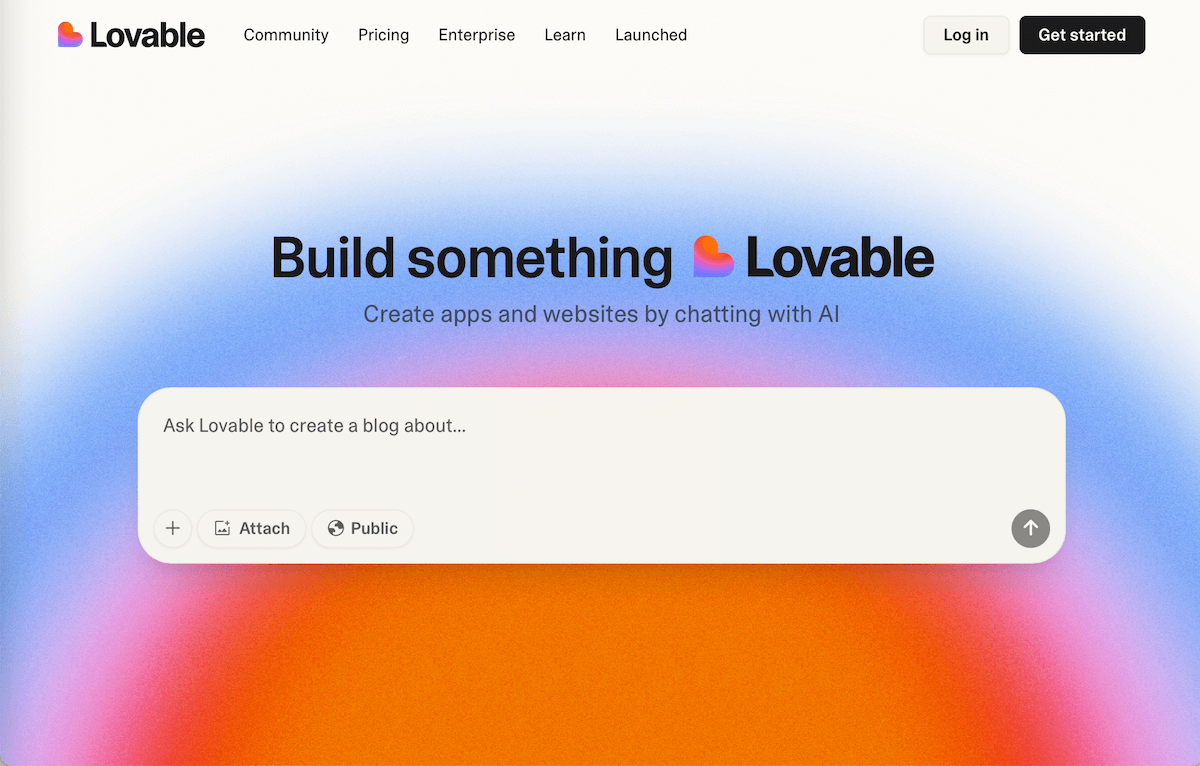
The popular AI platform Lovable from Sweden makes it possible to quickly create functioning web applications, tools or prototypes without the need for coding skills. Instead of writing code by hand, Lovable helps you turn ideas into interactive projects – from websites and landing pages to tools and dashboards.
TL;DR – Key Takeaways
No coding required: Lovable turns plain-English prompts into production-ready React/TypeScript web apps within minutes.
Full-stack capable: Native Supabase integration handles databases, authentication, and backend logic without leaving the editor.
Free tier available: 5 credits/day on the free plan; paid plans start at $20/month for serious builders.
Best for prototypes & MVPs, not a replacement for professional software development on complex, security-critical systems.
Lovable (formerly known as GPT Engineer) is an AI-powered, full-stack web app builder developed in Stockholm, Sweden. You describe what you want to build in plain language, and Lovable’s AI generates working React and TypeScript code in the background – including UI, logic, and optionally a connected database or API.
The platform is built for non-developers and technical founders alike. Whether you want a landing page, an internal dashboard, or an MVP with user authentication and a database, Lovable handles the scaffolding so you can focus on the idea itself. Projects can be deployed in one click and the code is yours to keep – it syncs to a GitHub repository automatically. You can extend Lovable projects with n8n workflow automation for backend processes.
Lovable is part of the fast-growing “vibe coding” movement alongside tools like AI Agents Guide“>AI coding agents and conversational IDEs. It raised significant funding to become one of Europe’s most prominent AI developer tools, often labeled an EU AI unicorn.
Core Features of Lovable
AI Code Generation via Prompt
At its heart, Lovable takes a natural-language prompt and produces a working web application. The generated code is based on React, TypeScript, Tailwind CSS, and shadcn/ui – a modern, production-quality stack. You can iterate through further prompts or make direct edits in the built-in code editor.
GitHub Integration
Every Lovable project can be connected to a GitHub repository. Changes made through the AI or the code editor are committed automatically. This means you always own your code, can hand it off to a developer, or continue building locally with your preferred tools.
Supabase Backend & Database
Lovable has a native, one-click integration with Supabase – an open-source Firebase alternative. This lets you add persistent data storage, user authentication, Row Level Security, and REST/GraphQL APIs to your app without leaving the Lovable interface. Supabase is currently the only supported database backend.
One-Click Deployment
Finished projects can be published to a live URL directly from Lovable. You get a shareable link on a Lovable subdomain, or you can connect a custom domain. There is no need to configure a hosting provider or a CI/CD pipeline separately.
Remix & Community Projects
The Lovable community publishes thousands of public projects. Any public project can be “remixed” – cloned and modified as the starting point for your own work. This dramatically lowers the barrier to entry: instead of starting from scratch, you can fork a working app and adapt it to your needs.
Built-in Code Editor
Beyond prompts, Lovable includes a Monaco-based code editor (the same editor that powers VS Code). Technical users can jump in and refine the AI-generated code, fix edge cases, or add logic that the AI did not quite get right.
Collaboration (Team Plan)
On the Team plan, multiple users can work on the same project. This is especially useful for small product teams or founders who want to bring in a developer for polish without migrating away from Lovable.
Lovable vs. Bolt.new vs. Cursor vs. v0.dev – How Do They Compare?
The AI app builder market has become crowded fast. Here is how Lovable stacks up against the most relevant alternatives. Understanding these differences will help you pick the right tool for your use case. If you are interested in the broader landscape of AI Agents Guide“>AI agents and developer tools, there is a lot of overlap worth exploring.
Feature
Lovable
Bolt.new
Cursor
v0.dev
Primary use case
Full-stack web app builder
Full-stack web app builder
AI-augmented code editor
UI component generator
Coding knowledge required
No (helpful for complex tasks)
No (helpful for complex tasks)
Yes – developer tool
Helpful for integration
GitHub integration
Yes (native, auto-commit)
Yes
Yes (local repo)
Via Next.js export
Database / backend
Supabase (native)
Supabase, Firebase (manual)
Any (developer manages)
None (UI only)
One-click deployment
Yes (Lovable subdomain)
Yes (StackBlitz)
No (manual)
Yes (Vercel)
Free tier
Yes (5 credits/day)
Yes (limited tokens)
Yes (limited completions)
Yes (limited generations)
Tech stack output
React, TypeScript, Tailwind
React, Vue, Svelte, others
Any language/framework
React + Tailwind (shadcn)
Remix / community
Yes (featured projects)
Limited
No
No
Best for
Non-devs, founders, MVPs
Rapid prototyping
Professional developers
UI/design prototyping
Bottom line: Lovable and Bolt.new are the most direct competitors. Lovable edges ahead on its seamless Supabase integration and community/remix ecosystem. Cursor is a different category entirely – it’s a professional IDE for developers. v0.dev focuses purely on UI components rather than complete applications.
Lovable Pricing: Free, Pro, and Team
Lovable uses a credit-based pricing model. Each prompt that modifies your project consumes credits. Reading code, viewing previews, or browsing community projects does not cost credits.
Free Plan – $0/month
5 credits per day (resets daily)
All projects are public – visible to the Lovable community
Access to the code editor and GitHub sync
Supabase integration included
Remix and use community projects
Best for: experimenting, learning, and small personal projects
Lovable is versatile, but it shines in specific scenarios. Here are five real-world use cases where the tool delivers exceptional results:
1. Startup MVP in a Weekend
A non-technical founder wants to validate a SaaS idea before hiring a developer. With Lovable, they can build a working MVP – including a landing page, a signup form, and a basic dashboard – over a weekend. The Supabase integration handles user data securely. The resulting app can be shown to investors or early users to gather real feedback.
2. Internal Business Tools & Dashboards
Small businesses often need simple internal tools: an inventory tracker, a client status board, or a project pipeline view. These are exactly the kind of data-driven dashboards Lovable excels at. Connected to Supabase, the tool can read and write live data, replacing messy spreadsheets with a proper UI.
3. Landing Pages & Marketing Sites
Designers and marketers can describe a landing page – layout, copy, color scheme, CTAs – and Lovable generates a complete, responsive React site. Because the output is real code, it can be handed to a developer for final polish or deployed directly. No page builder lock-in.
4. Interactive Prototypes for Presentations
Instead of a static Figma mockup, product managers can use Lovable to build a clickable prototype that actually works in the browser. Stakeholders can interact with real UI elements, which is far more persuasive than slides. The WRLDS startup website mentioned in this review is a real-world example of this approach taken all the way to production.
5. Educational & Simulation Tools
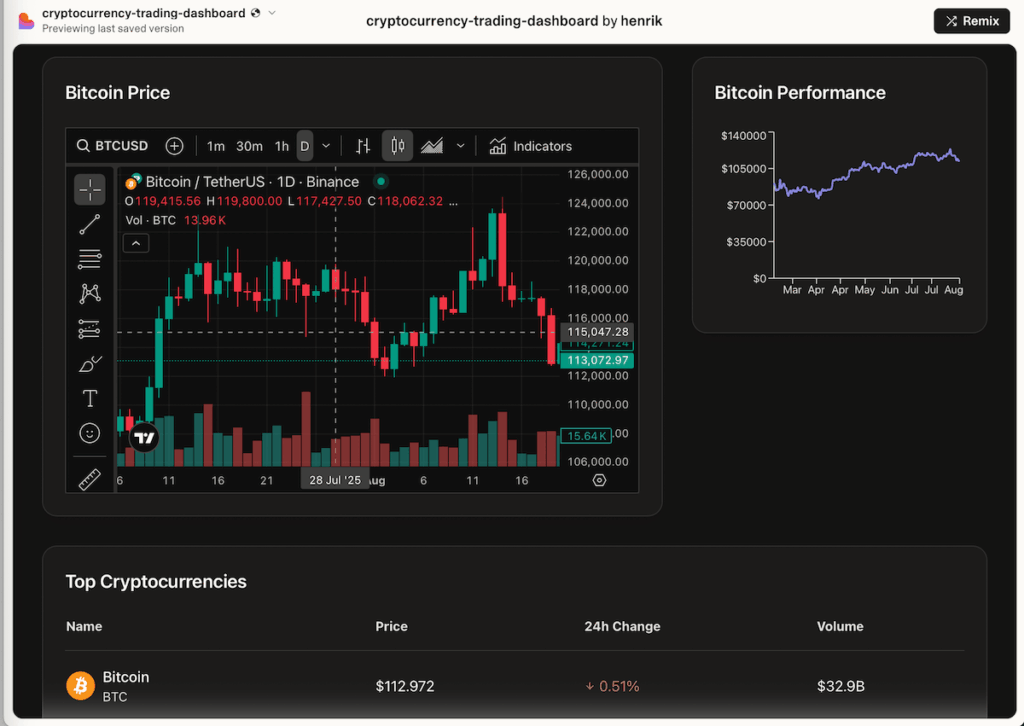
Educators and hobbyists use Lovable to build physics simulators, math tools, interactive timelines, or quiz apps. The community’s featured projects section is full of creative examples – from Mermaid diagram generators to crypto trading dashboards. These are fun, functional, and built in hours rather than weeks. Tools like this overlap with the broader world of ChatGPT Guide“>AI tools for learning and productivity.
Lovable Review: Pros and Cons
Pros
Genuinely no-code: The prompt interface is accessible to anyone who can describe what they want clearly. You do not need to know React or TypeScript.
Production-quality stack: The generated code uses modern, widely-adopted technologies. It is not toy output – developers can continue where Lovable left off.
Supabase integration is seamless: Setting up authentication and a database normally takes hours. Lovable reduces this to a few prompts.
You own the code: GitHub sync means you are never locked into Lovable. The code is yours, full stop.
Active community: Thousands of public projects provide inspiration and a shortcut via remixing.
Fast iteration: From idea to deployed prototype in under an hour is genuinely achievable for straightforward projects.
Cons
Credit limits can be frustrating: Complex projects require many iterations. The free plan’s 5 credits/day runs out quickly. Pro credits ($20/month for 100) can also feel restrictive on larger builds.
AI errors accumulate: On complex features, the AI can introduce bugs that are hard to undo through prompting alone. Some technical knowledge helps to diagnose these.
Not suitable for security-critical applications: AI-generated code requires careful review before handling sensitive user data in production. The disclaimer in the original article is warranted.
Supabase-only backend: If you need a different database or backend service, Lovable’s native integrations won’t cover it. You’d need to add custom code.
Limited for very complex apps: Lovable is ideal for MVPs and tools. Large-scale, complex enterprise applications require professional development practices it cannot replace.
Public projects on free plan: Your free-tier projects are visible to all Lovable users. This is a dealbreaker for confidential work.
“Tools like Lovable represent a fundamental shift in how software gets built. The bottleneck in product development is no longer ‘can we build it?’ – it’s ‘did we build the right thing?’ When non-technical founders can build and test their own MVPs, that validation loop compresses from months to days. That’s the real value here, not the code.”
What Can You Create with Lovable?
With Lovable, creative and useful web projects can be developed in no time at all. The possibilities range from websites, landing pages, and illustrative simulation tools to data-driven analysis applications, dashboards, and business applications such as simple CRMs or ERPs. You can also build AI Agents Guide“>AI-powered applications that call external APIs or process user input intelligently.
You create these applications simply by prompt. Lovable generates the code for the front end in the background and, if required, even a back end with API or database connection. The code – largely based on TypeScript – can then be further customized via prompt or directly in the code editor. This makes it possible to create impressive projects in a very short time.
Popular Project Examples with Lovable
If you want to see Lovable projects in action, you can use the following sources. They give you a fast, practical impression of how versatile Lovable can be.
Featured Projects: In the community area of the website, you can see project examples of the free version of Lovable in action and test or remix them directly.
Lovable Launched: Projects that have already been published live are shown on the dedicated Launched website. Users can vote and the projects quickly gain a platform to attract new users.
We have taken a look at some of the projects launched here and present them as inspiration for your own Lovable builds.
Disclaimer: This article does not constitute a recommendation or legal assessment of the Lovable platform. All content, projects and links mentioned here originate from external providers and are their responsibility. We assume no liability for the accuracy, safety or legality of the content presented. Users should exercise particular caution when entering sensitive data and, if in doubt, inform themselves in advance about possible risks.
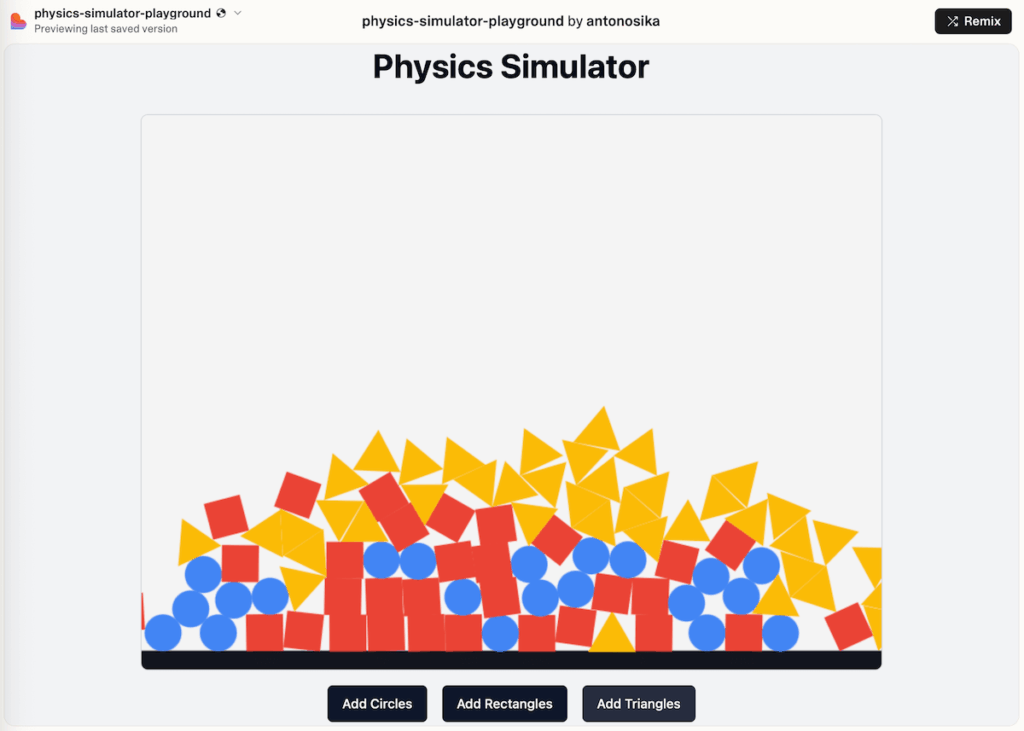
Lovable Project: Physics Simulator
Fun: In the physics simulator, you can click to create hundreds of triangles, circles and squares, which then behave physically and bounce and slide off each other.
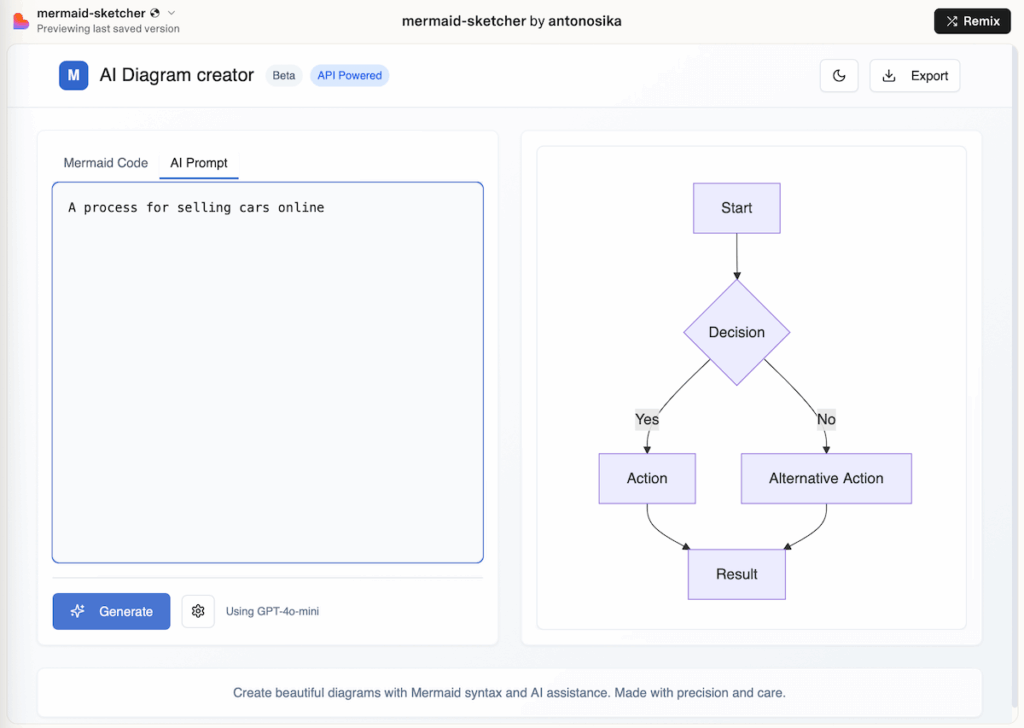
Useful: You can use the AI prompt to generate a diagram with the Mermaid language to quickly show a flowchart for illustration purposes. To do this, you need to enter your OpenAI key (tip: remix the project, check the code, then enter the sensitive key).
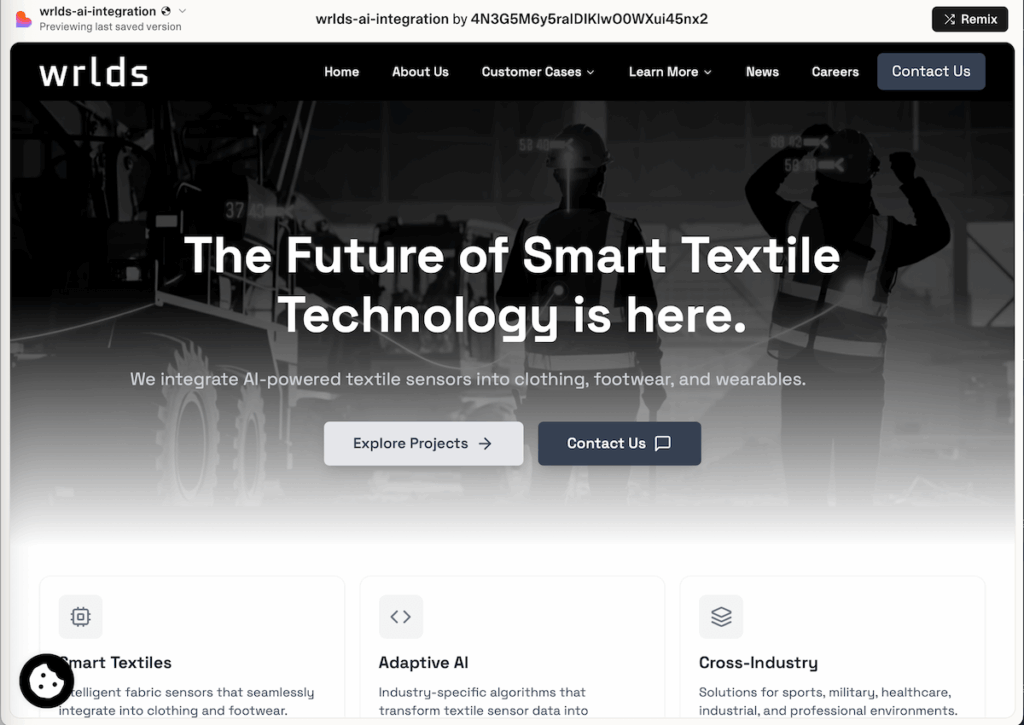
Lovable Project: Website of the Tech Start-up “WRLDS”
Impressive: The textile tech startup WRLDS from Sweden has apparently created its entire website, including the news section, with Lovable. This shows how powerful Lovable is when it comes to website creation.
Lovable can be used for free with 5 credits per day, which corresponds to roughly 5 meaningful prompts. In the free version, all projects are publicly visible in the community. With the remix function, you can copy any existing public project and adapt it further. If you need privacy or more credits, the Pro plan starts at $20/month.
What is the difference between Lovable and Bolt.new?
Both tools are AI-powered full-stack web app builders targeting non-developers. The main differences are in their community ecosystem and backend integrations. Lovable has a mature community with thousands of remixable projects and a native, deeply integrated Supabase connection. Bolt.new supports a wider range of frontend frameworks (Vue, Svelte, etc.) but its community features are less developed. Both are excellent – your choice may depend on which ecosystem appeals to you more.
Coding vs. no-code: What are the limits of Lovable?
Lovable does not replace professional software development. The generated code is real React/TypeScript, but it is AI-authored, which means errors can occur – including logic bugs and potential security vulnerabilities. For rapid prototypes, landing pages, and internal tools, Lovable delivers impressively mature results. For complex, security-critical, or large-scale production systems, the AI-generated code should be thoroughly reviewed and hardened by a qualified developer.
Is Lovable trustworthy and secure?
Lovable the platform is a legitimate, VC-backed company based in Sweden. However, because anyone can publish a project on Lovable’s free tier, you should exercise caution with any third-party Lovable project you encounter – just as you would with any unfamiliar website. Never enter sensitive personal information into an unverified project. Generative AI makes it easy to create convincing interfaces quickly, which can also be misused by bad actors.
How can you learn Lovable?
Lovable has a shallow learning curve because you work in natural language. However, understanding basic web development concepts, UX design principles, and how to write clear prompts (“vibe coding”) will dramatically improve your results. For database-connected apps, you will also need to understand Supabase basics – how to set up tables, configure Row Level Security, and manage API keys. Here are recommended starting points:
The EU unicorn Lovable from Sweden impressively demonstrates how far generative AI has come in web development. Prototypes, websites, and even more complex applications can be created in just minutes – a clear advantage for founders, creatives, and anyone who wants to ship ideas quickly. The remix function and community projects make it easy to get inspired and start building without deep coding knowledge.
At the same time, the limitations are real: AI-generated code can introduce bugs and security issues, and Lovable is not a substitute for professional software development on complex systems. It is best understood as a powerful rapid prototyping and MVP tool, with the expectation that production hardening may require developer involvement later.
The bottom line: Lovable is one of the most capable AI app builders available in 2025–2026. If you want to validate an idea fast, build an internal tool, or create a functional prototype without hiring a development team, it deserves a serious look. The free tier costs nothing to try.
Ready to build your first app?Start with Lovable’s free plan and remix a community project to see what’s possible in under an hour. And if you want to explore more AI developer tools and AI Agents Guide“>AI agents, check out our full coverage on AI Rockstars.
AI Rockstars verdict
TL;DR: Lovable is useful for quickly turning product ideas into working web app prototypes through AI-assisted development. Its value is strongest in early product discovery, MVPs, internal tools, and founder-led iteration.
Editorial recommendation: Use Lovable to move from idea to testable product quickly, but review generated code, data handling, authentication, accessibility, and maintainability before treating an app as production-ready.
Ralf Schukay is a co-founder of AI Rockstars and specializes in AI automation and enterprise solutions. He tests and compares AI tools for professional use and helps teams become more productive through workflow automation.
To provide the best experiences, we use technologies like cookies to store and/or access device information. Consenting to these technologies will allow us to process data such as browsing behavior or unique IDs on this site. Not consenting or withdrawing consent, may adversely affect certain features and functions.
Functional
Always active
The technical storage or access is strictly necessary for the legitimate purpose of enabling the use of a specific service explicitly requested by the subscriber or user, or for the sole purpose of carrying out the transmission of a communication over an electronic communications network.
Preferences
The technical storage or access is necessary for the legitimate purpose of storing preferences that are not requested by the subscriber or user.
Statistics
The technical storage or access that is used exclusively for statistical purposes.The technical storage or access that is used exclusively for anonymous statistical purposes. Without a subpoena, voluntary compliance on the part of your Internet Service Provider, or additional records from a third party, information stored or retrieved for this purpose alone cannot usually be used to identify you.
Marketing
The technical storage or access is required to create user profiles to send advertising, or to track the user on a website or across several websites for similar marketing purposes.