Related to multiple guides. For full context, see our ChatGPT Guide & Claude AI Guide.
How AI Rockstars evaluates this update
AI Rockstars evaluates MiniMax M2: China’s open-source AI model challenges OpenAI and Claude by checking official product information, availability, pricing or cost impact, workflow relevance, integration depth, and whether the update changes a practical decision for teams. This article should be read as an AI-news explainer: verify current access, terms, and model behavior before using the tool in production.
What should readers do next?
Use this post to understand the update, then compare it with the broader Claude AI guide and the AI Rockstars planning tools. For business use, check whether the tool improves quality, saves time, reduces cost, or adds integration risk before rolling it into a workflow.
Which official sources should readers compare?
Technical superiority through efficient architecture
The technical foundation of MiniMax M2 is based on a highly optimized Mixture-of-Experts implementation that is significantly more efficient than comparable models. For example, while DeepSeeks V3.2 uses 37 billion active parameters, MiniMax M2 uses only 10 billion and still achieves comparable or better performance. This efficiency enables responsive agent loops and higher parallel processing with the same computing budget. The model shows its strengths particularly in code-specific benchmarks. On SWE-Bench Verified, MiniMax M2 achieves a score of 69.4 percent, outperforming GLM-4.6 with 68 percent. On Terminal-Bench, which tests the ability to execute command line tasks, the model scores 46.3 percent and outperforms both GPT-5 and Claude Sonnet 4.5. This performance makes MiniMax M2 particularly valuable for software development and automated programming tasks.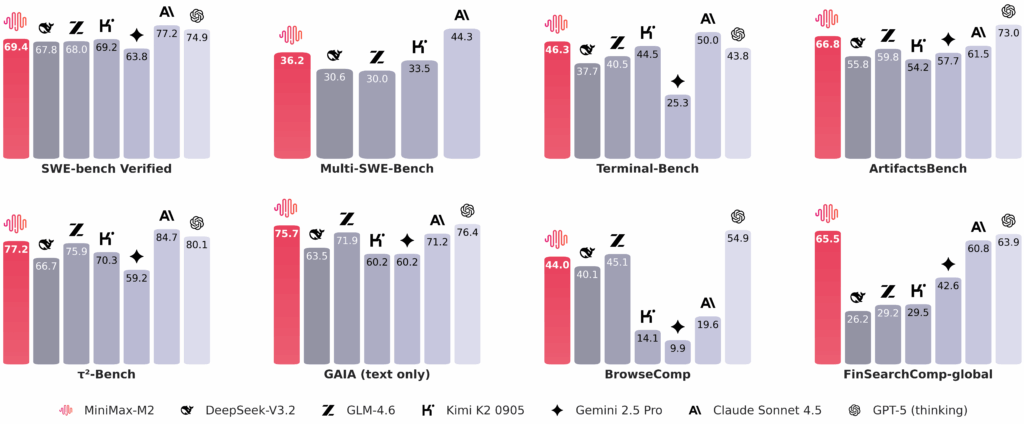
Read also: Xcode 26.3: Agentic Coding with Claude & Codex
Strategic impact on the global AI market
Full open-source availability under MIT license via Hugging Face democratizes access to frontier-class AI capabilities. Organizations can run the model locally, meeting privacy requirements without relying on external APIs. This strategy contrasts strongly with the proprietary orientation of OpenAI and Anthropic and could fundamentally challenge their business models. China invested around 132.7 billion dollars in AI development between 2019 and 2023, which explains the simultaneous emergence of several frontier-class models such as DeepSeek R1, Qwen 2.5-Max and GLM-4.5. This efficiency-driven development was partly driven by US export restrictions on advanced semiconductors, which forced Chinese developers to optimize algorithms and architecture instead of simply scaling parameters and training data.The most important facts about the update
- MiniMax M2 achieves 5th place worldwide in AI benchmarks as the best open source model
- Cost advantage of 92 percent compared to Claude Sonnet with comparable performance
- Double the inference speed with 1,500 tokens/second vs. 900 for Claude
- Mixture-of-Experts architecture with 230B total parameters, only 10B active
- Fully open source under MIT license available via Hugging Face
- Specialization in agent workflows and code generation
- IPO plans for 2025 as the first Chinese “AI Tiger” startup
- Recognizedby NVIDIA CEO Jensen Huang as a global AI innovation leader
AI Rockstars verdict
TL;DR: MiniMax M2 is relevant as part of the broader competition around efficient, capable AI models for agents, coding, and multimodal workflows. The important test is task performance, reliability, cost, and integration fit.
Editorial recommendation: Evaluate MiniMax M2 with the same prompts and tasks used for incumbent models. Do not switch on benchmark claims alone; test coding, reasoning, latency, tool use, and failure behavior in your own workflows.
MiniMax M2 model evaluation criteria
| Scenario | Recommendation | Why it matters |
|---|---|---|
| Task accuracy | Critical | The model must solve real tasks, not just score well in demos. |
| Latency and cost | High | Efficient models can improve product margins and user experience. |
| Tool and agent fit | High | Agent workflows need reliable function calling and instruction following. |
| Failure behavior | Critical | Teams need to know where the model breaks and how often. |
FAQ
What should MiniMax M2 be compared against?
Compare it against the models already used in your workflow with identical prompts, tools, and evaluation criteria.
Are AI model benchmarks enough?
No. Benchmarks are useful signals, but production tasks reveal reliability, cost, and integration issues.
Who should test MiniMax M2?
AI product teams, engineering teams, and agent builders should test it if model cost, speed, or capability mix matters.