The most important information in brief
- Google unveils Gemini 3.1 Pro with a massive performance leap to 77.1 percent in the ARC-AGI-2 benchmark.
- The model follows an “agentic-first” approach with direct integration into CLI and Android Studio for complex workflows.
- Developers receive support for high-end coding, including the generation of interactive 3D interfaces and animated SVGs.
📖 This article is part of our Google Gemini guide. Read the full guide →
Google is poised to make the next leap in the AI race, redefining the bar in coding and logical thinking with its new model. In a detailed blog post, Google describes Gemini 3.1 Pro as the most powerful tool to date, specifically designed for agent workflows and complex problem solving. Rather than just generating text, this update aims to take on autonomous development tasks on a completely new platform.
Read also: Google Gemini: New check recognizes AI-generated videos
The innovations in detail
The technical data shows that Google has not only delivered incremental improvements here, but has also optimized the architecture for reasoning.
- Benchmark explosion: Probably the most impressive figure is the performance in ARC-AGI-2 (Abstraction and Reasoning Corpus). At 77.1 percent, Gemini 3.1 Pro has more than doubled the performance of its predecessor. This benchmark is considered the toughest test for logical generalization, as it forces models to recognize new patterns instead of just recalling what they have memorized.
- High-end coding capabilities: While previous models often failed due to syntax errors, 3.1 Pro generates complex, visual outputs. The model creates directly usable, animated SVGs and functional, interactive 3D interfaces. It moves away from simple code snippets to the creation of entire front-end components.
- Platform integration “Antigravity”: The launch will take place on the new “Google Antigravity” platform . To support the “agent-first” approach, the model is deeply integrated into developer tools, including full support for the command line interface (CLI) and Android Studio.
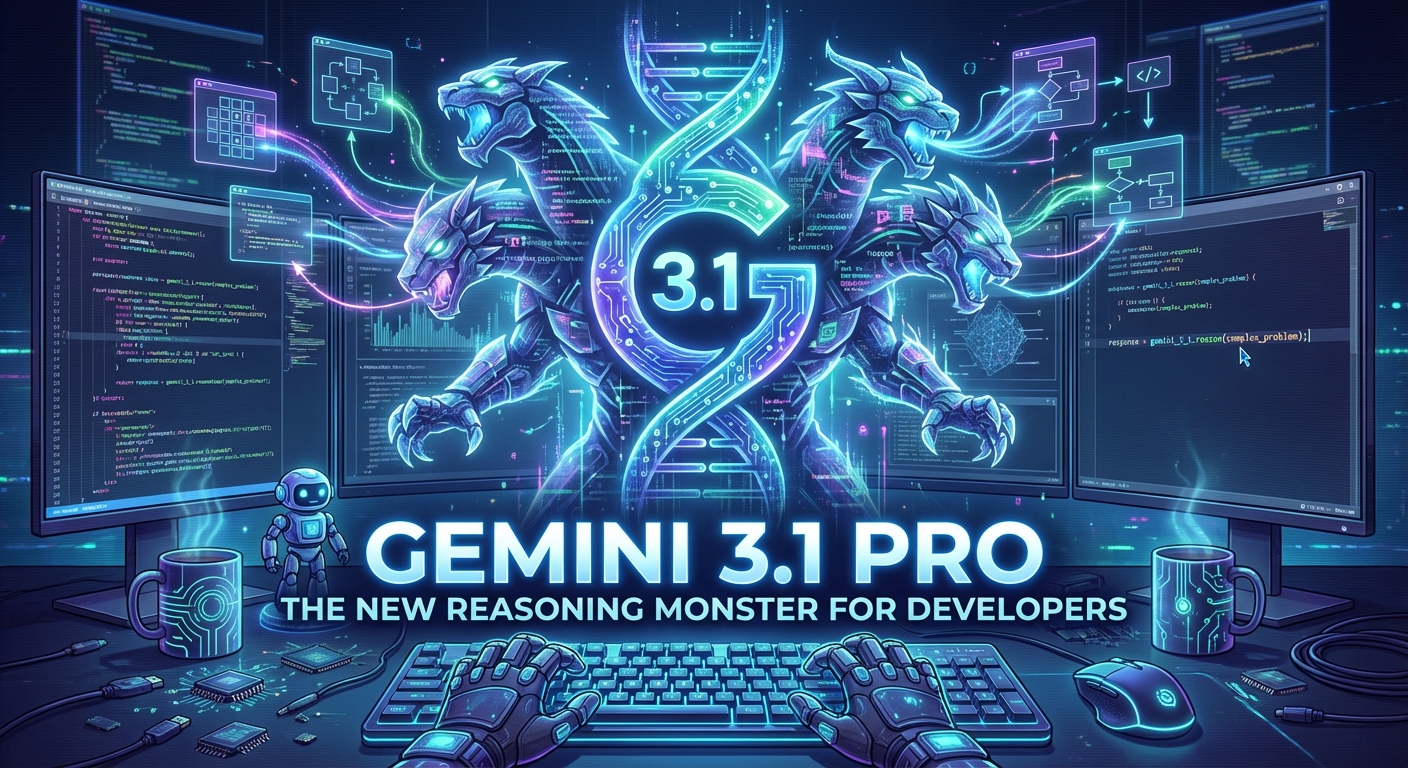
“Gemini 3.1 Pro is not just a chatbot, but a reasoning monster for developers that is capable of autonomously solving abstract logic patterns.”
Why it matters
This update marks a paradigm shift from “generation” to “action.” The dramatic leap in the ARC-AGI-2 benchmark is a key indication that Gemini 3.1 Pro can perform real logical transfer instead of just calculating probabilities.
For professional developers, the focus on agentic workflows and integration into the CLI means that AI is evolving from a “pair programmer” to an autonomously acting agent in the terminal. Google’s specific emphasis on 3D interfaces and animations as output directly attacks competing models, which often still have problems with spatial understanding or complex visual code structures. It is a clear attempt to regain supremacy in the high-end coding market and put pressure on tools such as Cursor and GitHub Copilot.
Availability & Conclusion
Gemini 3.1 Pro is now available via the new ‘Google Antigravity’ platform and in the corresponding developer tools (Android Studio, CLI).
Conclusion: With this release, Google is forcing the competition to act. If the benchmark values in ARC-AGI-2 are confirmed in everyday developer use, Gemini 3.1 Pro is currently the most powerful tool on the market for complex logic and coding tasks.
Gemini 3.1 Pro vs. Competitors: How Does It Stack Up?
\n
Choosing the right AI model in 2025 means comparing concrete capabilities, not just marketing claims. Here is how Gemini 3.1 Pro measures up against GPT-5 from OpenAI and Claude Opus 4.6 from Anthropic across the dimensions that matter most for real-world use.
\n\n
| Feature | Gemini 3.1 Pro | GPT-5 | Claude Opus 4.6 |
|---|---|---|---|
| ARC-AGI-2 Score | 77.1% ✓ | ~75% (est.) | Not published |
| Context Window | 2,000,000 tokens ✓ | 128,000 tokens | 200,000 tokens |
| Multimodal Input | Text, image, audio, video, code | Text, image, audio | Text, image |
| Pricing (API) | From $3.50 / 1M input tokens | From $15 / 1M input tokens | From $15 / 1M input tokens |
| Free Tier Available | Yes (Gemini Advanced trial) | Limited (via ChatGPT Plus) | No (Pro plan required) |
| Deep Research Mode | Yes (native) | Yes (via ChatGPT) | Partial (Projects) |
| Workspace Integration | Deep (Google Workspace) ✓ | Microsoft 365 (Copilot) | None native |
| Developer API | Google AI Studio / Vertex AI | OpenAI API | Anthropic API |
\n
\n
Table data based on publicly available information as of March 2025. API pricing may vary by tier and region. ARC-AGI-2 scores reflect published or estimated results at time of writing.
\n\n\n
Key Features of Gemini 3.1 Pro
\n
Gemini 3.1 Pro is not an incremental update — it represents a genuine architectural leap. Below are the five capabilities that define its current competitive position.
\n\n
1. 77.1% on ARC-AGI-2: A Reasoning Benchmark Leader
\n
The ARC-AGI-2 benchmark was specifically designed to be resistant to brute-force memorization. It tests fluid intelligence — the ability to solve novel problems that require genuine reasoning, not pattern recall. Gemini 3.1 Pro’s 77.1% score is the highest recorded for any commercially available model at this time, surpassing prior frontrunners and placing it meaningfully closer to human-level performance (humans average around 85%).
\n
For practitioners, this matters in applications where the model must handle ambiguous instructions, multi-step logical chains, or tasks it has never seen before. Code debugging, legal reasoning, and complex data analysis are areas where this benchmark advantage translates directly into better results.
\n\n
2. 2-Million-Token Context Window: The Largest in Commercial AI
\n
A 2-million-token context window means Gemini 3.1 Pro can process roughly 1,500 full PDF pages, multiple books, or an entire enterprise codebase in a single prompt. No other commercially available model currently matches this capacity.
\n
This is not just a technical specification — it changes what is possible. Legal teams can load entire contract histories. Developers can feed a complete repository for refactoring. Researchers can synthesize hundreds of papers in one pass. The model does not need to summarize or compress; it reads everything. Learn more about how this compares across models in our Gemini overview.
\n\n
3. Native Multimodal Capabilities: Text, Image, Audio, Video, and Code
\n
Unlike models that bolt on multimodal features as an afterthought, Gemini 3.1 Pro was built from the ground up to process multiple modalities natively. It can read an image and answer questions about it, transcribe and analyze audio, interpret video frames in sequence, and generate or debug code — all within the same conversation and context window.
\n
This native integration is significant because information does not get lost between modality \”handoffs.\” A user can upload a screen recording of a software bug, ask for a written explanation, and receive working corrected code — in one request, with full contextual awareness throughout.
\n\n
4. Deep Research Mode: Autonomous Multi-Step Investigation
\n
Deep Research is Gemini 3.1 Pro’s agent-style research capability. When activated, the model autonomously plans a research strategy, browses the web across dozens of sources, synthesizes findings, and produces a structured long-form report — all without requiring the user to prompt each step manually.
\n
Early benchmarks from Google indicate Deep Research can complete tasks in minutes that would take a human researcher several hours. The feature is particularly effective for competitive intelligence, scientific literature reviews, and market analysis — use cases where breadth and synthesis quality matter as much as raw accuracy.
\n\n
5. Google Workspace Integration: AI Built Into Your Daily Tools
\n
Gemini 3.1 Pro powers the AI features inside Google Docs, Sheets, Slides, Gmail, and Meet through Google Workspace. This goes beyond simple autocomplete: the model can draft complete documents with context from your Drive, generate pivot-table logic in Sheets, summarize lengthy email threads, and produce meeting notes from recordings.
\n
For organizations already running on Google Workspace, this integration removes the friction of switching between tools. The AI operates inside familiar interfaces, with access to organizational context — meaning it can reference past documents and emails to produce output that is relevant, not generic.
\n\n\n
\n
\”The ARC-AGI-2 result is the number I have been watching closely, because it is specifically engineered to resist the shortcuts that made earlier benchmarks unreliable. Gemini 3.1 Pro crossing 77% is not a marginal improvement — it signals that the model has a qualitatively different kind of reasoning capability. When you combine that with a two-million-token context window, you are looking at a system that can hold an entire business problem in working memory and reason across it systematically. That changes the ROI calculation for enterprise AI deployments quite fundamentally.\”
\n
\n
\n\n\n
How to Access Gemini 3.1 Pro: 4 Steps
\n
Getting started with Gemini 3.1 Pro is straightforward. Depending on your use case — personal productivity, API development, or enterprise deployment — there are different entry points. Here is the fastest path for most users.
\n\n
- \n
- \n Go to gemini.google.com and sign in with your Google account.
\n The free tier gives you access to Gemini’s standard models. To unlock Gemini 3.1 Pro specifically, you will need a Google One AI Premium plan (currently $19.99/month), which also includes 2TB of Drive storage and access to Gemini inside Google Workspace apps.\n - \n Activate Google One AI Premium or a Google Workspace Business plan.
\n Individual users can subscribe to Google One AI Premium directly from the Gemini interface or via the Google One app. Business and enterprise users should access Gemini through Google Workspace Admin — this route provides additional data governance controls and compliance features.\n - \n For developers: access via Google AI Studio or Vertex AI.
\n Visit aistudio.google.com to experiment with Gemini 3.1 Pro using the API — Google AI Studio offers a free quota to get started. For production deployments, Google Cloud Vertex AI provides enterprise-grade SLAs, fine-tuning options, and regional data residency. API pricing starts at $3.50 per million input tokens, making it substantially more cost-efficient than comparable frontier models.\n - \n Start with a specific high-value use case, not a general test.
\n The capabilities of Gemini 3.1 Pro — especially the 2M-token context and Deep Research mode — only become apparent when you give the model a genuinely complex task. Upload a large document, run a multi-step research query, or feed it a sizable codebase. Generic \”hello world\” prompts will not reveal what differentiates this model from its predecessors. For prompt strategies and workflow ideas, see our full Gemini resource hub.\n
\n
\n
\n
\n
\n\n\n
Frequently Asked Questions About Gemini 3.1 Pro
\n\n
Is Gemini 3.1 Pro free?
\n
Gemini 3.1 Pro is not available on Google’s free tier. Access requires a Google One AI Premium subscription ($19.99/month for individuals) or a qualifying Google Workspace plan. Developers can access the model via API through Google AI Studio, which includes a free usage quota, but sustained or production-level use requires a paid API account. The free Gemini tier gives access to lighter models — Pro is the flagship, paid tier.
\n
\n\n
What is Gemini 3.1 Pro’s ARC-AGI-2 score?
\n
Gemini 3.1 Pro scores 77.1% on the ARC-AGI-2 benchmark, which is the highest published score for any commercially available AI model at the time of writing. ARC-AGI-2 tests fluid reasoning — the ability to solve genuinely novel problems — rather than factual recall, making it one of the more reliable indicators of real-world reasoning capability. By comparison, average human performance on the same benchmark sits around 85%, meaning Gemini 3.1 Pro is approaching but has not yet reached human-level performance on this measure.
\n
\n\n
How does Gemini 3.1 Pro compare to GPT-5?
\n
Gemini 3.1 Pro and GPT-5 are closely matched on most reasoning benchmarks, but Gemini 3.1 Pro holds a clear advantage in two areas: context window size (2M tokens vs. 128K for GPT-5) and API pricing (starting at $3.50 vs. $15 per million input tokens). GPT-5 benefits from a more mature developer ecosystem and tighter Microsoft 365 integration for Windows-centric organizations. For use cases that require processing large documents or long codebases in a single pass, Gemini 3.1 Pro is currently the stronger choice. For teams already embedded in the OpenAI/Microsoft stack, GPT-5 may offer less friction.
\n
\n\n
What is the context window of Gemini 3.1 Pro?
\n
Gemini 3.1 Pro has a 2-million-token context window — the largest of any commercially available language model. In practical terms, 2 million tokens corresponds to approximately 1,500 pages of dense text, several full-length books, or a large enterprise software codebase. This allows the model to process and reason across extremely large volumes of information in a single request without needing to truncate, summarize, or split content across multiple calls. The full 2M context is available via the API on Vertex AI; availability may vary by access tier.
\n
\n
\n\n\n