Part of our Claude AI Guide. For the full picture, see our complete Claude AI Guide.
How AI Rockstars evaluates this update
AI Rockstars evaluates Desktop Extensions: Anthropics One-Click AI-Integration transformiert Claude Desktop by checking official product information, availability, pricing or cost impact, workflow relevance, integration depth, and whether the update changes a practical decision for teams. This article should be read as an AI-news explainer: verify current access, terms, and model behavior before using the tool in production.
What should readers do next?
Use this post to understand the update, then compare it with the broader Claude AI guide and the AI Rockstars planning tools. For business use, check whether the tool improves quality, saves time, reduces cost, or adds integration risk before rolling it into a workflow.
Which official sources should readers compare?
.dxt files.
The security architecture outperforms traditional extension models through local data processing, isolated execution environments and dynamic authorization systems. Cryptographic hashing during startup blocks modified extensions, while behavioral circuit breakers trigger automatic shutdowns in the event of anomalies.
Developer ecosystem and enterprise adoption
GitHub metrics show over 1,200 forks of Anthropic DXT examples within 72 hours of launch. Developer surveys confirm that 84% of respondents can prototype extensions in under two hours. The@anthropic-ai/dxt CLI standardizes development workflows through manifest validation, dependency packaging and automatic protocol compliance checks.
JPMorgan Chase demonstrates enterprise scalability by deploying 5,000 . dxt extensions via Microsoft Intune within 48 hours. Real-time trade compliance checks against local regulatory databases result in 40% faster audit resolution without data exfiltration risks. Kubernetes rollouts for extensions such as SecureShare enable cross-team collaboration without cloud dependencies.
Read also: Claude Sonnet 4.6: The massive coding & agent update
Market positioning and competitive analysis
DXT fundamentally diverges from cloud-based AI agents through on-device processing with 5-20ms latency versus 100-500ms for cloud alternatives. Full offline functionality and zero data leakage guarantees position DXT in the context of the Future Today Institute forecast that 70% of enterprise AI will migrate to edge deployment by 2027. The synergies with Claude Code enable AI-assisted extension development via Natural Language Specifications. Bidirectional MCP support for remote servers such as Jira and Slack establishes hybrid local-cloud toolchains. OAuth token integration prevents credential hardcoding and addresses critical security concerns of early MCP implementations.Summary
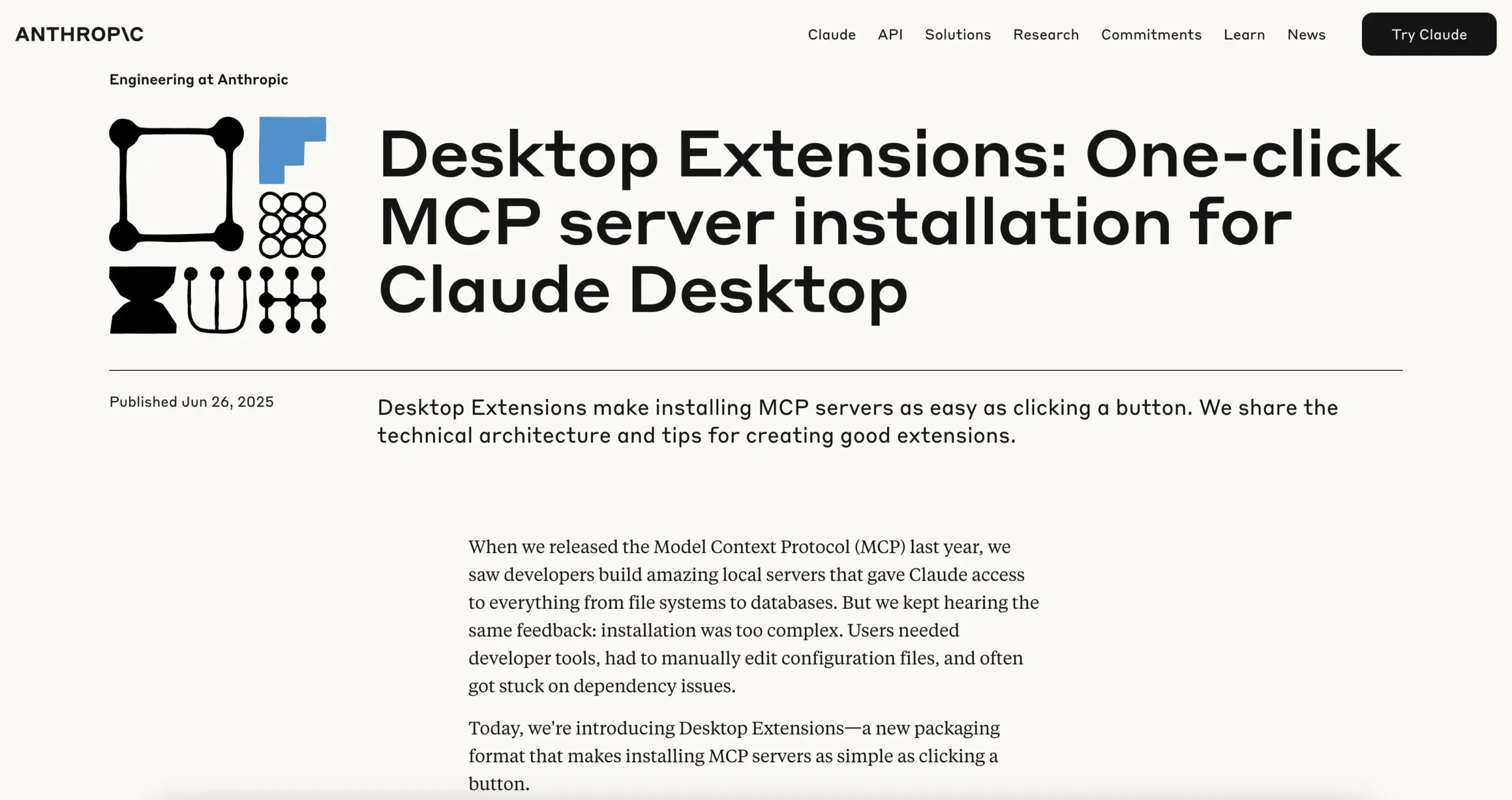
- Desktop Extensions transform MCP server installation from multi-hour to 15-second deployments
- Containerized architecture packs complete runtimes, dependencies and security schemas into single
.dxt files - 300% increase in MCP server deployments documented since DXT launch
- Enterprise adoption demonstrated by JPMorgan Chase with 5,000 extensions in 48 hours
- Security model outperforms traditional extensions through local processing and isolated execution
- Developer ecosystem demonstrates 1,200 GitHub forks and 84% successful 2-hour prototyping rate
- Market differentiation through on-device processing with 5-20ms latency versus cloud competition
- Future forecast supports 70% edge AI migration by 2027 according to industry forecasts
AI Rockstars verdict
TL;DR: Claude Desktop Extensions are relevant for MCP-style integrations, desktop agents, and reusable Claude tools.
Editorial recommendation: Keep this page indexable as a supporting cluster asset and refresh it after material product changes.
Indexing decision
| Factor | Decision | Why it matters |
|---|---|---|
| Cluster value | High | This page strengthens Claude integrations and desktop workflows. |
| Search intent | Technical or product research | The topic maps to a recognizable product, platform, model, or workflow. |
| Maintenance | Refresh on material changes | Keep capabilities, availability, and positioning current. |
FAQ
Why is Claude Desktop Extensions relevant?
Claude Desktop Extensions is relevant because it connects to Claude integrations and desktop workflows.
How should teams evaluate Claude Desktop Extensions?
Evaluate workflow fit, output quality, integrations, reliability, cost, security, and governance.
Is the article a current buying guide?
Use it as strategic context and verify current product details, pricing, and availability before decisions.