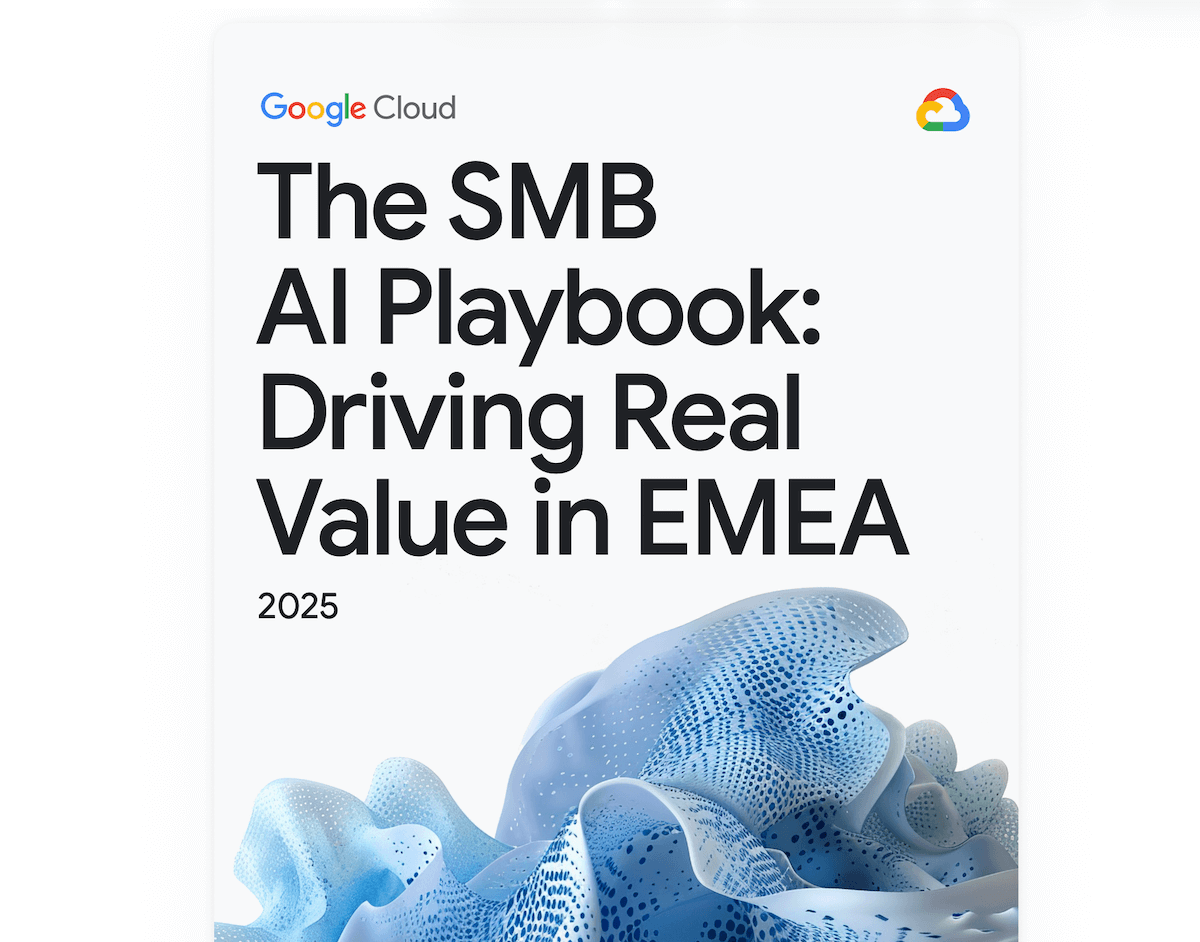
The new Google SMB AI Playbook 2025 shows concrete practical examples of how SMEs are already using AI effectively today. The free PDF from Google provides companies with plenty of inspiration for greater efficiency through AI and new digital opportunities in over 50 use cases.
The Google SMB AI Playbook uses concrete examples to show how small and medium-sized enterprises are already using AI productively today.
The use cases are taken from the free white paper “The SMB AI Playbook: Driving Real Value in EMEA (2025)” from Google.
The focus is on practical use cases along central business areas – from strategy and marketing to operations and compliance. Technical solutions from the Google Cloud are also presented, such as the AI platform VertexAI, the data warehouse solution BigQuery and other Google technologies from the Google Cloud.
1. AI for business strategy & management
AI helps management teams and executives to better understand markets, identify risks at an early stage and make data-based decisions.
1. Sentiment analysis from public data: Public content such as news, blogs or forums are automatically analyzed to identify sentiment, trends and reputational risks around markets, competitors or industries.
2. Peer Benchmarking & ESG Scoring: Internal and external data is analyzed to compare the company’s own ESG performance and business development with competitors.
3. Automated performance monitoring & reporting: Dashboards and reports are created automatically, anomalies are identified and relevant KPIs are continuously monitored.
In the supply chain, AI ensures better planning, fewer bottlenecks and lower costs.
31. Stock categorization & segmentation: Stocks are automatically grouped in a meaningful way.
32. Real-time inventory management: stock movements are continuously monitored.
33. Inventory forecasting & optimization: Demand is predicted and reorders are optimized.
34. Location forecasts for store expansions: New locations are evaluated based on data.
35. Automated order processing: Orders, invoices and reconciliations are automated.
36. Vendor selection: Suppliers are compared based on price, quality and performance.
37. Returns forecasting: Returns are predicted and better planned.
8. Finance & Accounting
Financial processes become faster, more accurate and more transparent.
38. Automated financial reconciliation: postings and transactions are reconciled automatically.
39. Automated invoice verification: incoming invoices are compared with orders and deliveries.
9. Legal, Risk, Security & Compliance
AI reduces manual checking effort and improves risk and compliance management.
40. Automated contract review: contracts are analyzed according to risks, deadlines and clauses.
41. Contract clustering & summaries: Large volumes of contracts are grouped and summarized.
42. Contract queries in natural language: Content can be searched by question.
43. Customer risk forecasting: Payment and default risks are forecast.
44. Vulnerability assessments: IT systems are automatically checked for vulnerabilities.
45. Threat detection: Suspicious activities are detected in real time.
46. Real-time compliance monitoring: New regulatory requirements are checked automatically.
47. Audit preparation: Evidence and reports for audits are created automatically.
10. Operations
In day-to-day operations, AI increases efficiency, collaboration and transparency.
48. Workforce forecasting: personnel requirements are planned based on data.
49. AI assistant for knowledge work: internal information, documents and tasks are supported centrally.
50. Document and article remarginization: Long content is automatically summarized.
51. Multilingual team communication: Internal communication is automatically translated.
Conclusion: Practical use case collection for brainstorming and technology
The use cases make it clear that AI is no longer a topic for the future, but a tool for day-to-day business operations. With manageable effort, some of the use cases shown can create measurable added value in SMEs. Google offers suitable solutions for every use case in the Google Cloud, from databases to generative AI models and more. The Google Playbook provides use cases from small to large for almost all areas in companies and organizations. Conclusion: It’s worth downloading and reading for 1 hour!
To provide the best experiences, we use technologies like cookies to store and/or access device information. Consenting to these technologies will allow us to process data such as browsing behavior or unique IDs on this site. Not consenting or withdrawing consent, may adversely affect certain features and functions.
Functional
Always active
The technical storage or access is strictly necessary for the legitimate purpose of enabling the use of a specific service explicitly requested by the subscriber or user, or for the sole purpose of carrying out the transmission of a communication over an electronic communications network.
Preferences
The technical storage or access is necessary for the legitimate purpose of storing preferences that are not requested by the subscriber or user.
Statistics
The technical storage or access that is used exclusively for statistical purposes.The technical storage or access that is used exclusively for anonymous statistical purposes. Without a subpoena, voluntary compliance on the part of your Internet Service Provider, or additional records from a third party, information stored or retrieved for this purpose alone cannot usually be used to identify you.
Marketing
The technical storage or access is required to create user profiles to send advertising, or to track the user on a website or across several websites for similar marketing purposes.