Part of our Claude AI Guide. For the full picture, see our complete Claude AI Guide.
How AI Rockstars evaluates this update
AI Rockstars evaluates Analysis of Claude Opus 4.5: Autonomous coding capabilities and cost efficiency by checking official product information, availability, pricing or cost impact, workflow relevance, integration depth, and whether the update changes a practical decision for teams. This article should be read as an AI-news explainer: verify current access, terms, and model behavior before using the tool in production.
What should readers do next?
Use this post to understand the update, then compare it with the broader Claude AI guide and the AI Rockstars planning tools. For business use, check whether the tool improves quality, saves time, reduces cost, or adds integration risk before rolling it into a workflow.
Which official sources should readers compare?
Performance leap in software engineering
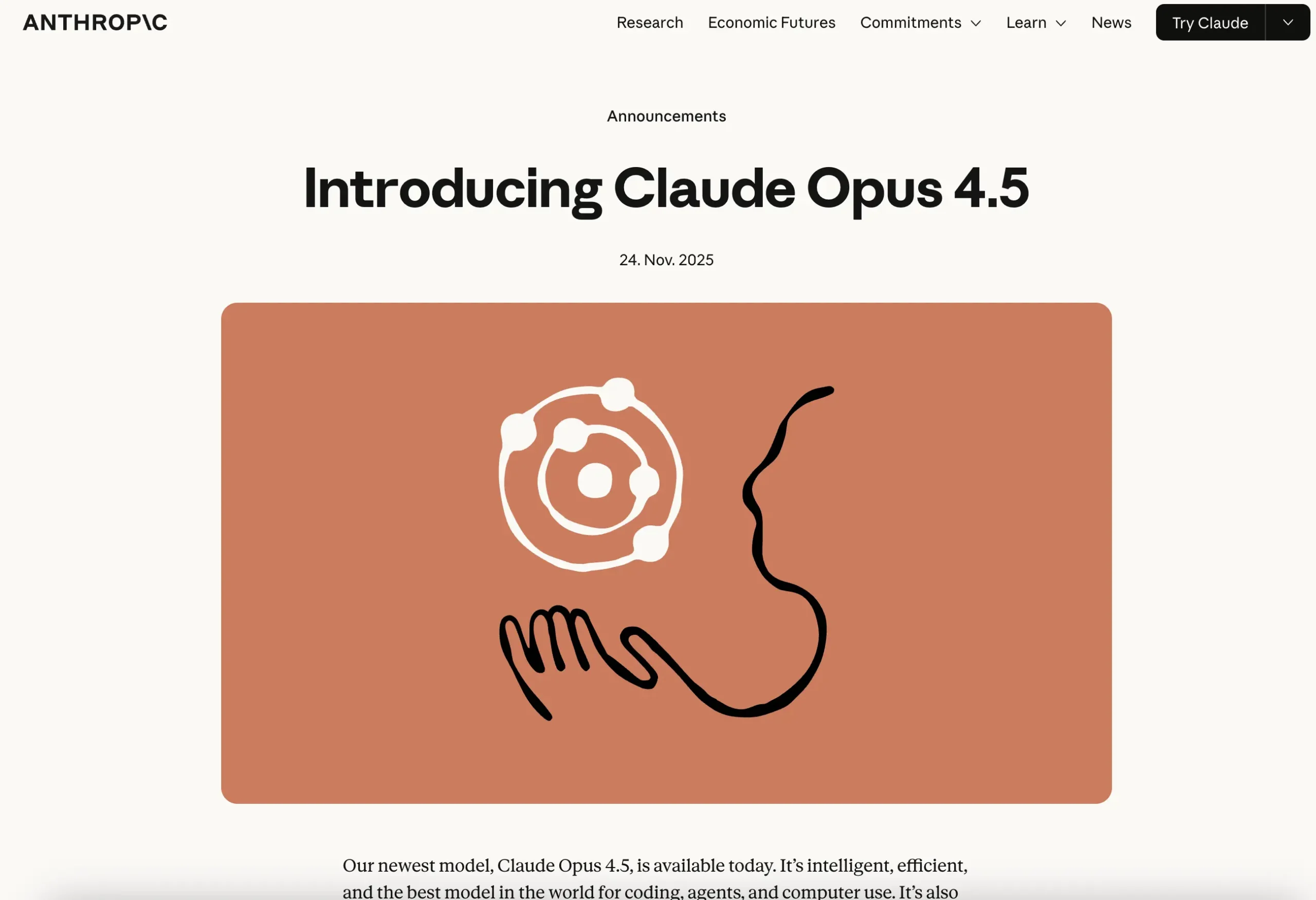
The Claude Opus 4.5 model presented on November 24, 2025 is positioned at the top of the current frontier models. With a score of 80.9 percent on SWE-bench Verified, it is the first AI system to break the 80 percent mark in solving real-world software problems. This performance surpasses both the recently released GPT 5.1 Codex Max from OpenAI and Google Gemini 3 Pro. Of particular relevance to the industry is the model’s ability to maintain context across long chains of interaction. Anthropic retains the 200,000-token context window, but optimizes internal processing so that “thinking blocks” – the model’s thought steps – are preserved across the entire dialog. This eliminates redundant computational steps and enables consistent problem solving for complex architectural decisions in the code. In addition to pure computing power, Anthropic addresses the economic hurdles of implementing high-end models. The price has been drastically reduced by 67 percent compared to its predecessor Opus 4.1. The cost is now 5 US dollars per million input tokens and 25 US dollars per million output tokens. This aggressive pricing is aimed at moving the use of Opus-level intelligence from the niche of specialized high-security applications to the broader developer community. Analysts see this as a direct response to pricing pressure from Gemini 3 Pro and a strategy to consolidate the market for enterprise solutions.Granular control and extended tool usage
A major innovation for developers is the so-called Effort parameter. This allows dynamic control of the compromise between response quality, latency and costs. Users can choose between the “Low”, “Medium” and “High” levels. While the high setting offers maximum thoroughness for critical production codes or financial analyses, the medium setting enables an efficient balance for prototyping tasks. This feature shifts the decision-making authority over the depth of reasoning from the model back to the developer and enables precise budgeting of AI resources within applications.Read also: Claude Sonnet 4.6: The massive coding & agent update
In the area of multimodal interaction, Claude Opus 4.5 significantly expands computer use capabilities. A new zoom function enables the detailed analysis of specific screen sections in full resolution. This eliminates previous weaknesses in the recognition of small UI elements or fine fonts in screenshots. This is supplemented by the “Tool Search Tool”, which allows agents to dynamically load required tools from extensive catalogs instead of permanently storing all definitions in context. This reduces token consumption in complex agent workflows by up to 85% and simultaneously increases the reliability of tool selection.The most important facts about the update
- Coding performance leadership: Claude Opus 4.5 achieves 80.9 percent on SWE-bench Verified, setting a new industry standard for autonomous software development.
- Aggressive pricing strategy: The cost of ownership has been reduced by 67 percent (5 USD input / 25 USD output), lowering the barrier to widespread adoption.
- Effort parameter: Developers actively control the ratio of computational effort to depth of analysis across three levels (Low, Medium, High).
- Optimized tool usage: Dynamic reloading of tools (“tool search”) massively reduces token consumption in agent workflows.
- Improved computer control: New zoom functions allow more precise interaction with user interfaces and desktop applications.
- Security focus: Despite extended autonomy, the model has improved values in the defense against prompt injections and a reduced rate of unjustified denials.
AI Rockstars verdict
TL;DR: Claude Opus 4.5 remains relevant as a major model milestone for reasoning, coding, and autonomous workflows.
Editorial recommendation: Keep this page indexable as a supporting cluster asset and refresh it when the underlying product, model, or framework changes materially.
Indexing decision
| Factor | Decision | Why it matters |
|---|---|---|
| Cluster value | High | The page supports advanced Claude reasoning and coding workflows. |
| Search role | Supporting evergreen context | The topic is an identifiable AI product, model, framework, or workflow. |
| Maintenance | Periodic review | Refresh product capabilities and availability when they materially change. |
FAQ
Why is Claude Opus 4.5 relevant?
Claude Opus 4.5 is relevant because it connects to advanced Claude reasoning and coding workflows.
How should teams evaluate Claude Opus 4.5?
Evaluate workflow fit, reliability, integrations, cost, governance, and measurable outcomes.
Is this article a current buying guide?
Use it as strategic context and verify current pricing, availability, and product details before decisions.