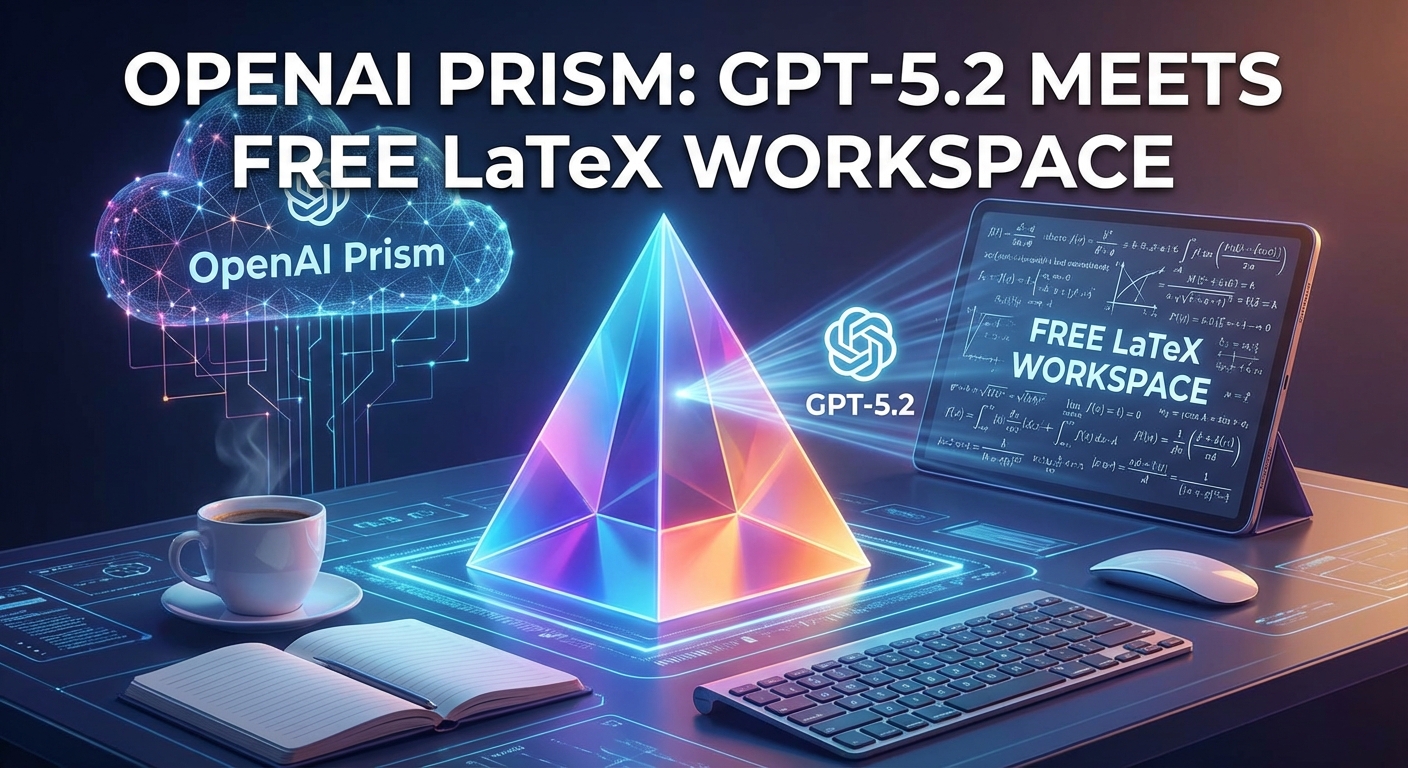
OpenAI has released Prism, an AI-native environment for scientific writing that is deeply integrated with the new GPT-5.2 model family and native LaTeX support. The tool aims to replace established editors with automated “vision-to-code” workflows, but faces massive criticism for privacy risks to unpublished research and logical weaknesses in the fast “instant” model. We sort through the technical specifications and community reactions.
- Benchmark dominance: The flagship GPT-5.2 Pro model achieves a record success rate of 93.2% on the GPQA Diamond Benchmark, outperforming human experts in complex scientific questions.
- Competitive comparison of latency & context: While Prism focuses on deep integration, competitor Claude 3.5 Sonnet delivers comparable coding results in 20% of the time, and Google Gemini 3 continues to lead with a context window of 10 million tokens.
- Aggressive pricing strategy: OpenAI offers Prism free of charge in the current free tier for private accounts in order to enforce “vertical lock-in” in the scientific community before monetizing the enterprise segment.
- Reliability paradox: Despite high-level reasoning, the system suffers from “silent breakdowns” in deterministic tasks, with simple mathematical operations being significantly more prone to errors than complex physical derivations.
📖 This article is part of our comprehensive ChatGPT guide. Read the full guide →
The ecosystem: Prism and the GPT-5.2 architecture
With the official launch of OpenAI Prism on January 28, 2026, OpenAI is making a strategic pivot: away from a pure chat interface and toward deep integration into scientific production. Prism is not a “better chatbot,” but an AI-native scientific writing environment.
From chat window to cloud workshop
Technologically, Prism is based on the acquisition of the LaTeX platform Crixet. Instead of moving blocks of text back and forth between ChatGPT and an editor such as Overleaf via copy and paste, users work directly in a cloud IDE. The model does not act as an external advisor, but as a co-author with direct access to the source code.
The GPT-5.2 hierarchy
Under the hood of Prism is the GPT-5.2 model family, released on December 11, 2025. OpenAI strictly differentiates between application purpose and compute cost:
| Model variant | Focus & strengths | Ideal area of application |
|---|---|---|
| GPT-5.2 Instant | Low latency: Optimized for speed, feels “snappy.” | Fast drafting, syntax corrections, rewrites. |
| GPT-5.2 Thinking | Reasoning: Uses “extended thinking” (further development of o1 technology), but is faster than its predecessors. | Complex logical conclusions, structuring of arguments. |
| GPT-5.2 Pro | High-Compute:The flagship model. Slower, but with maximum precision. Reach 93.2% on _GPQA Diamond_. | Final validation, complex scientific Q&A, peer review simulation. |
Deep Integration: The end of “amnesia”
Prism’s unique technical feature is its native LaTeX integration. The model has read and write access to the entire project structure.
- Full Context Awareness: GPT-5.2 Thinking analyzes BiBTeX files, embedded graphics (figures), and linked
.tex filesin parallel. - No loss of context: Where classic chat windows suffer from “amnesia” during long conversations and forget previous instructions, Prism maintains a permanent overview of the entire paper and referenced sources thanks to its direct editor connection.
Pricing strategy
OpenAI is focusing on aggressive distribution. Prism is currently available free of charge in the Free Tier for users with a private ChatGPT account – including unlimited projects and collaborators. This strategy aims to establish a “vertical lock-in” in the scientific community before the planned rollout for ChatGPT Team and Enterprise customers, which is to be monetized.
Read also: GPT-5.3 Codex: The autonomous coding agent is here
Practical guide: Workflow automation for scientific writing
OpenAI Prism differs from classic LLM interfaces in its architecture as a native LaTeX editor. The model does not act as an external advisor, but operates directly on the file structure of the project. This enables workflows that were hardly feasible using copy-paste prompts alone.
Below, we demonstrate the process of vision-to-code conversion, one of the most powerful features of the new environment.
1. From whiteboard to vector graphics code
Manually recreating complex diagrams in TikZ is notoriously time-consuming. With Prism, this step is automated.
- Input & setup: The user drags and drops a simple smartphone photo of a whiteboard sketch (e.g., the architecture of a neural network) into the Prism editor.
- Prompting: Instead of describing the code character by character, you use the visual recognition of GPT-5.2 Pro:
> “Convert this sketch into a TikZ diagram using theneuralsnetworklibrary. Label the hidden layers exactly as shown.” - Generation: The model analyzes the spatial arrangement of the nodes in the image and writes syntactically correct LaTeX code directly into the document.
\begin{tikzpicture}
  \draw[input] (0,0) -- (1,0) node[midway,above] {$x_1$};
  % GPT-5.2 generates the complete code here based on
  % the visual topology of the sketch.
\end{tikzpicture}
2. Interactive refinement (refinement loop)
Since Prism maintains the full project context, corrections can be made iteratively without having to regenerate the entire code.
- Scenario: The preview window shows a connection between two layers that was ambiguous in the photo.
- Workflow: The user does not have to search the code. A prompt such as “Remove the skip connection between layer 2 and 4” is sufficient.
- Result: Prism identifies the corresponding lines in the TikZ block, deletes them, and immediately triggers a recompilation in the background for validation.
3. Integrated bibliography management
Prism eliminates the context switch between browser (research) and editor (BiBTeX maintenance). By connecting to external databases, GPT-5.2 can take over the “busywork” of citation.
- Command: “Find relevant citations for ‘Sparse Mixture of Experts’ from 2024-2025 and add them to my .bib file.”
- Execution:
- Access to real metadata via the Arxiv interface.
- Automatic formatting of the BibTeX entry.
- Insertion into the
.bib file, making the new key (\cite{...}) immediately available in the main text.
This reduces the risk of “hallucinations” in references, as the model draws on real database entries instead of inventing titles.
Recommended: Xcode 26.3: Agentic Coding with Claude & Codex
Market analysis: Prism head-to-head with Claude and Gemini
With the release of Prism and the GPT-5.2 family, OpenAI is leaving the field of pure “general purpose” chatbots and aiming for deep integration into subject-specific workflows. A direct comparison with the market leaders from Anthropic and Google shows that, in January 2026, the models will no longer differ only in terms of raw intelligence, but also in terms of their positioning.
Here is an overview of the current technical status:
| Feature | OpenAI Prism / GPT-5.2 | Claude 3.5 Sonnet / Opus 4.5 | Google Gemini 3 / NotebookLM |
|---|---|---|---|
| Primary focus | Scientific Writing & Reasoning: Deeply integrated with LaTeX. Strong in mathematical proofs and structure. | Coding & Nuance:Considered a leader in “human-like” writing style and pure software engineering (Claude Code). | Data & Context:Unbeatable with huge contexts (10M tokens) and data analysis across the Google ecosystem. |
| Model behavior | Thinking mode:Slow, methodical, plans steps ahead (high latency). | Agile:Claude Sonnet often delivers comparable quality in 20% of the time (low latency). | Multimodal:Leading in native video and audio processing, weaker in strict logic. |
| Biggest weakness | Consistency:Tends to experience “silent breakdowns” during simple tasks (e.g., parity checks). | Pricing:Opus 4.5 is often more expensive than the competition in terms of API calls per token. | UX fragmentation:Powerful features are often spread across different tools in a confusing manner. |
Reasoning vs. coding: The battle for the niche
OpenAI clearly sets itself apart with Prism: While Claude 3.5 Sonnet and Opus 4.5 continue to be regarded as the gold standard for coding and nuanced text generation in the developer community, Prism occupies the niche of hard science. The strength of GPT-5.2 “Thinking” lies not in creative flow, but in the rigid processing of logical chains. Those who need pure Python code often prefer to use Anthropic; those who need to derive a complex formula in a paper and visualize it directly in TikZ benefit from Prism’s deep integration.
Strategic classification: “Vertical lock-in”
Perhaps the most important aspect of this launch is not the model itself, but the platform strategy. Google dominates the breadth (mass analysis of documents) with Gemini 3 and NotebookLM. OpenAI, on the other hand, is attempting to create a vertical lock-in among scientists with Prism.
The analogy is clear: Prism aims to become for researchers what GitHub Copilot has become for software developers. It is no longer just a chat window, but an “operating system for research.” By providing direct access to project files (BiBTeX, Figures), OpenAI is attempting to make itself indispensable before Google can fully integrate similar AI features into its Office suite.
While OpenAI’s marketing celebrates new records on the GPQA Diamond Benchmark, feedback from the community (including r/LocalLLaMA and HackerNews) paints a more nuanced picture. Criticism focuses on three fundamental problem areas that jeopardize the practical use of Prism in high-stakes scientific environments.
The intelligence paradox: genius vs. calculator
Despite the massive computing power of GPT-5.2 Pro and its ability to think through complex fluid dynamics simulations, the system fails at trivial logic. A widely cited Arxiv paper (“Even GPT-5.2 Can’t Count to Five”) proves that reliability drops significantly for simple deterministic tasks.
| Task category | Complex research (high-level) | Trivial logic (low-level) |
|---|---|---|
| Example | Analysis of PhD-level physics questions | Multiplication (`127 x 82`) or parity check (`11000`) |
| Performance | 93.2%success rate (surpasses experts) | Faulty(inconsistent results) |
| Consequence | High confidence in reasoning ability | Loss of confidence in basic calculations |
This behavior (“silent breakdowns”) is fatal in a scientific context: a model that supports complex theories but hallucinates when it comes to basic mathematics requires thorough human verification.
The “lobotomy” effect in instant mode
Many users report a noticeable regression in the GPT-5.2 Instant model compared to its predecessor (5.1). The accusation: the model is “over-sanitized.” The responses seem rhetorically smooth and corporate, with legitimate queries more often blocked by strict “safety filters.” Critics therefore often refer to Instant Mode as “lobotomized” – fast, but severely limited in its creative and problem-solving variance.
Data protection as a showstopper?
Perhaps the sharpest criticism of Prism comes from the privacy community on HackerNews. Since Prism is designed as a cloud-native environment, researchers must upload their LaTeX files, unpublished raw data, and sketches to OpenAI servers.
- IP risk: There is massive concern that sensitive research results (“intellectual property”) will unintentionally flow into the training of future models (“OpenAI farming scientists for insight”).
- Risk of leaks: Unlike with local LLMs, there is no guarantee that pre-published papers will not appear in other sessions due to security gaps or hallucinations.
Ethical concerns: “Overleaf on autopilot”
Prism blurs the line between tool and author. Critics warn of a flood of semi-synthetic papers in which the human author has hardly validated the code and text generated by the model in detail. The fear is that Prism not only makes writing easier, but also eliminates critical thinking – a scenario that could undermine scientific integrity in the long term.
Conclusion
OpenAI Prism is not an update, it is an aggressive expansion of territory. With the move from chatbot to cloud IDE, OpenAI is attempting to completely take over the scientific workflow (vertical lock-in). The promise is tempting: the Vision-to-TikZ function and context-aware working without “amnesia” solve real pain points in everyday academic life. But the product is schizophrenic: on the one hand, a brilliant co-author for complex chains of argumentation; on the other, an unreliable intern for trivial mathematics. Those who embrace Prism trade administrative hell (LaTeX formatting) for the necessity of permanent content control.
Who is Prism for?
- Use it if: You write academic papers and hate LaTeX diagrams. The ability to turn scribbled whiteboard sketches into perfect code in seconds is a massive productivity boost. It is also currently unrivaled for complex structuring (GPT-5.2 “Thinking”).
- Don’t use it if: You work with sensitive, unpublished data (IP) – the cloud requirement is a security risk. If you primarily develop software, stick with Claude 3.5 Sonnet; Anthropic is still ahead in coding. Never rely on Prism for simple calculations.
Action: Use the playground, but leave the door open
As long as the “Free Tier” is open to Plus users: Try it out! Use Prism as a tool for generating boilerplate code, graphics, and citations. But: Don’t treat it as your “single source of truth.” Don’t upload critical raw data and validate every footnote. OpenAI wants to lock you into its ecosystem – make sure you can switch back to Overleaf or a local editor at any time.