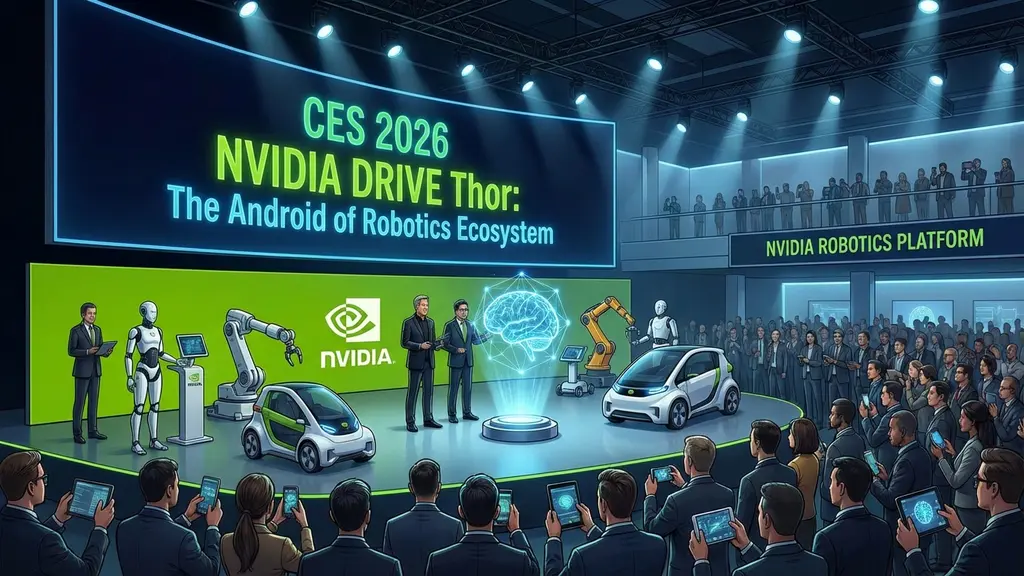
With Project GR00T and Jetson Thor, Nvidia is transforming itself from a pure chip supplier to a full-stack provider for humanoid robotics. The platform provides a standardized “nervous system” that replaces tedious hardware integration with software-based AI workflows. In future, you will no longer define motion sequences manually via code, but train robots directly using simulations and foundation models.
Nvidia’s platform strategy delivers the “Android for robots” and ends the costly fragmentation of the industry. You use a standardized nervous system instead of wasting years developing base drivers and middleware.
Shift to software engineering transforms your role from hardware tinkerer to AI architect. The focus is no longer on soldering, but on app logic and model training, while the hardware is abstracted.
Training at warp speed becomes real thanks to photorealistic simulations in Isaac Lab and Omniverse. Robots go through 10,000 hours of virtual experience in minutes to learn complex processes without hardware risk.
Control via natural language replaces tedious hard coding of motion paths in C . Thanks to Project GR00T, multimodal prompts translate your instructions directly into physical motor commands (text-to-action).
Strategic “buy vs. build” advantage reduces the barrier to market entry from years to months. Despite vendor lock-in, the investment in Nvidia’s stack pays for itself immediately by eliminating the need for in-house physics engine development.
More than just chips: The vision behind the “Android for robots”
Nvidia is currently undergoing a radical paradigm shift that goes far beyond supplying powerful hardware. While the company was previously known primarily as a producer of the GPU computing power that makes modern AI possible, Nvidia is transforming itself into a full-stack platform provider in the robotics sector. The strategy is clear: instead of just selling the motor, Nvidia now supplies the complete chassis, the control system and the driving school at the same time.
The concept: a universal basis for all
This strategy is often referred to as “Android for robots”, and the comparison is apt. Remember the smartphone era before 2007: every manufacturer had to write its own operating system. Then Android came along and provided a standardized basis on which Samsung, Xiaomi and co. could build. Nvidia is planning exactly this “unlock” for robotics. Industrial patriarchs such as Siemens or start-ups such as Figure AI should no longer have to spend years developing basic perception stacks or navigation algorithms from scratch. Nvidia provides the universal infrastructure – the digital nervous system – so that manufacturers can focus on the body and the specific use case of the robot.
Putting an end to the integration nightmare
The biggest problem with robotics development to date has been fragmentation. Anyone building a robot often spent 80% of their time writing individual drivers for cameras, making sensors compatible and “patching” middleware so that hardware A could talk to software B. This is where Nvidia is positioning itself. Nvidia is positioning itself as the central connector here. Hardware and software are decoupled through a standardized platform. For the ecosystem, this means standards instead of isolated solutions.
From hardware engineer to AI architect
For you as a developer, this change means a fundamental shift in skills. Robotics is transforming from a discipline of hardware engineering (soldering, wiring, low-level C-code) to a discipline of software engineering. The complexity of the physical world is being abstracted. In the future, you will primarily define the app logic and the behavior of the robot via AI models, while the Nvidia platform takes over the translation into physical motor commands. The aim is to make the development of a robot as accessible as programming an app.
Project GR00T, Thor and Isaac: the anatomy of the new ecosystem
To understand Nvidia’s claim as a platform provider, we need to look at the individual components. The company is not just supplying individual parts, but an integrated tech stack that functions like a biological organism.
The “brain” (compute): Jetson Thor
Your robot needs massive computing power that is also extremely energy efficient so as not to drain the battery in minutes. This is where Jetson Thor comes into play. This new on-board computer is based on the powerful Blackwell architecture and is specifically designed for humanoid workloads. Its main purpose: on-device AI. Instead of sending sensor data to the cloud for calculation (which would be fatal with unstable Wi-Fi), Thor processes complex Transformer models directly at the edge. With a performance of 800 teraflops, it ensures that the robot can interact in real time.
The “mind” (Foundation Models): Project GR00T
Hardware alone is not enough. Project GR00T (Generalist Robot 00 Technology) is the foundation model that teaches the robot to understand the world. Unlike in the past, where developers had to hardcode every movement (“Move arm X by 10 degrees”), GR00T uses multimodal AI. It processes speech, video and live sensor data simultaneously. You simply specify the goal (e.g. “Make me a sandwich”), and the model dynamically generates the necessary instructions based on the visual understanding of its environment.
The “gym” (simulation): Isaac Lab & Omniverse
Before you unleash a robot on the physical world, it needs to practice – and fast. This is where Nvidia Isaac Lab and Omniverse act as a virtual training camp. Physically correct laws apply in these photorealistic simulations (digital twins).
This allows reinforcement learning at warp speed: a robot can simulate 10,000 hours of experience in just a few minutes by running through thousands of scenarios in parallel. It learns to grasp, walk and navigate virtually without damaging any hardware.
The “nervous system” (OSMO)
To connect all these parts, Nvidia uses OSMO. This is the cloud-native orchestration layer. It synchronizes the training workflows in the data center with the robot’s local data streams and ensures seamless deployment of the trained models to the Jetson Thor.
Platform vs. product: Nvidia compared to the competition
To understand Nvidia’s strategy, you have to separate between those who dig for gold and those who sell the shovels. While companies like Tesla (with the Optimus), Boston Dynamics or Figure AI are working on a specific end product, Nvidia provides the infrastructure for the entire market.
This is comparable to the smartphone market: Tesla operates in a similar way to Apple – a closed system consisting of its own hardware and software. Nvidia, on the other hand, is positioning itself as the “Android” of robotics. They provide the technological foundation (Project GR00T, Jetson Thor, Isaac Lab) on which every other manufacturer – from logistics start-ups to industrial giants – can develop their own robots. Nvidia is therefore not competing directly with robot manufacturers, but is enabling them to scale AI-controlled humanoids.
A common misunderstanding among developers concerns the relationship with the Robot Operating System (ROS). Does Nvidia want to displace the industry standard? Quite the opposite. Nvidia Isaac ROS is a collection of hardware-accelerated packages based on ROS 2. Instead of replacing ROS, Nvidia injects its CUDA performance directly into the framework. While ROS provides the communication structure (the “installation pipe”), Nvidia provides the highly optimized algorithms for perception and navigation that would otherwise have to be laboriously written in-house.
The difference in the development approach is drastic, as the following comparison shows:
Feature
Traditional robotics development
Nvidia ecosystem (AI-native)
Programming
Hard-coded C & scripts for specific movements
Generative AI prompts & imitation learning
Iteration
Slow & risky on physical hardware
Rapid prototyping in simulation (Isaac Sim)
Scaling
Limited by hardware availability
Unlimited by parallel training in the cloud
Focus
Hardware engineering & mechanics
Software engineering & AI model training
This approach shifts the added value: you no longer primarily build better joints, but train a smarter brain that can be used universally.
The new workflow: from text prompt to physical action (Sim2Real)
Forget the tedious hard-coding of motion paths in C . Nvidia’s new stack transforms development from classic engineering to an AI-driven workflow. Your day-to-day work as a robotics developer is shifting massively into the virtual world.
This is what the modern workflow looks like in practice:
Definition via natural language: instead of programming servo angles, you define the task using multimodal prompts. Thanks to foundation models such as Project GR00T, the system understands instructions such as: “Detect defective parts on assembly line A and place them in the red box.”
Data generation & training: You don’t have millions of real photos of defective parts? No problem. In the Omniverse, you generate synthetic data (Synthetic Data Generation). You clone your environment and let the AI “see” thousands of variants of the parts under different lighting conditions.
Simulation & validation: Before a physical motor wobbles, the robot trains in the “Gym” (Isaac Lab). Using reinforcement learning, the AI tries out millions of movement sequences in accelerated time. Camera vision, physics and collisions are simulated with pixel precision.
Deployment (zero-shot transfer): As soon as the “policy” (the learned behavior) is stable, you flash the neural network to the edge device (e.g. Jetson Thor). The robot immediately applies what it has learned in the simulator in the real world without you having to teach it again manually.
Example scenario: The warehouse logistics robot
Imagine you are developing a mobile manipulator for a warehouse.
Prompt: “Drive to shelf 4, identify all cartons with the label ‘Fragile’ and stack them on the pallet.”
Sim: In the simulation, you let the robot drive against virtual obstacles, simulate slippery floors or blinding sunlight through hall windows. The AI learns to recognize the label even when it is half covered.
Real: On the real robot, the system navigates smoothly around a forklift truck standing in the way – a situation it has never physically experienced, but has simulated thousands of times.
Tech tip: Beware of the “sim-to-real gap”
The most critical point in this workflow is the gap between simulation and reality.
Domain randomization is mandatory: never train your model in a perfect, static environment. Vary textures, friction values, camera positions and lighting extremely widely in the simulation. This is the only way to make the model robust enough for the “dirty” reality.
Latency optimization: Text-to-action sounds good, but eats up computing power. Make sure that the inference times on the Jetson module remain low. A delay of 200ms between “seeing” and “grasping” can already lead to failure with running assembly lines.
Strategic classification: Vendor lock-in and market entry barriers
Despite all the excitement about Nvidia’s technical leaps, as a strategy decision-maker or founder you must also weigh up the business implications. While Nvidia’s “Android approach” democratizes access to high-end robotics, it also creates new dependencies.
The calculation: costs vs. development time
At first glance, the license costs for Nvidia’s enterprise tools – especially for the Omniverse platform and Isaac Sim – seem daunting for start-ups with tight budgets. But the classic “buy vs. build” logic applies here. The question is not whether you can afford the license, but whether you can afford to spend two years developing your own physics engine and simulation environment. Nvidia provides a massive shortcut here. For most players, the financial investment pays for itself almost immediately through the engineering time saved.
The golden cage: vendor lock-in
The biggest risk lies in the so-called “walled garden”. If you build your entire software stack on Nvidia Isaac, Omniverse and CUDA, you are entering a deep dependency. The code is highly optimized for Nvidia’s hardware (like the Jetson Thor). A later switch to chips from AMD, Intel or specialized TPUs will be extremely painful to impossible, as the entire AI inference and simulation pipeline is based on Nvidia’s proprietary interfaces. You trade flexibility for speed and performance.
Years become months
Despite the lock-in risk, the impact on time-to-market is undeniable. Until now, building a humanoid robot was a research project that took several years. The preliminary work of Project GR00T and the simulation in digital twins transforms this into an integration process of just a few months. This drastically lowers the barriers to market entry: in future, it will no longer be the teams with the best hardware expertise that win, but those with the cleverest data sets and app ideas.
Physical AI: the next cycle
We are at the beginning of a new era. While ChatGPT and Claude have revolutionized the world of digital information, Nvidia is now introducing “Physical AI”. This is the next logical step after LLMs: AI that not only understands the physical world, but manipulates it. Nvidia is positioning itself as the inevitable infrastructure provider for this next big tech cycle.
Conclusion: Your ticket to the “Android moment” of robotics
Nvidia’s transformation from chip supplier to platform architect marks the beginning of the era of physical AI. We are currently experiencing the same tipping point as in 2007 with smartphones: hardware is becoming a commodity, while software and the ecosystem determine the true value. For you, this means a radical democratization: you no longer have to be a hardware giant to build complex robots.
The deal offered by Nvidia is transparent: you enter the “golden cage” (vendor lock-in via CUDA and Isaac), but in return you get access to an infrastructure that shortens your development cycles from years to months. In a winner-takes-all market, speed almost always wins. If you try to write physics engines yourself instead of using established standards, you will be left behind technologically.
💡 Your next steps for practice:
Hands-on instead of theory: install Nvidia Isaac Sim (via Omniverse). Experiment with synthetic data before investing a single euro in physical prototypes.
Customize skill set: Close the gap between your AI team and the mechanics department. Your developers need to learn how to use domain randomization to close the sim-to-real gap. This is the core skill of the future.
Use case before tech: Don’t use the time gained for gimmicks, but for app logic. What specific problem does your robot solve? Thanks to Project GR00T, the “how” is solved – concentrate fully on the “what”.
The tools are ready – now it’s up to you not only to build the robot, but to make it intelligent.
To provide the best experiences, we use technologies like cookies to store and/or access device information. Consenting to these technologies will allow us to process data such as browsing behavior or unique IDs on this site. Not consenting or withdrawing consent, may adversely affect certain features and functions.
Functional
Always active
The technical storage or access is strictly necessary for the legitimate purpose of enabling the use of a specific service explicitly requested by the subscriber or user, or for the sole purpose of carrying out the transmission of a communication over an electronic communications network.
Preferences
The technical storage or access is necessary for the legitimate purpose of storing preferences that are not requested by the subscriber or user.
Statistics
The technical storage or access that is used exclusively for statistical purposes.The technical storage or access that is used exclusively for anonymous statistical purposes. Without a subpoena, voluntary compliance on the part of your Internet Service Provider, or additional records from a third party, information stored or retrieved for this purpose alone cannot usually be used to identify you.
Marketing
The technical storage or access is required to create user profiles to send advertising, or to track the user on a website or across several websites for similar marketing purposes.