Part of our AI Image Generation Guide. For the full picture, see our complete AI Image Generation Guide.
How AI Rockstars evaluates this update
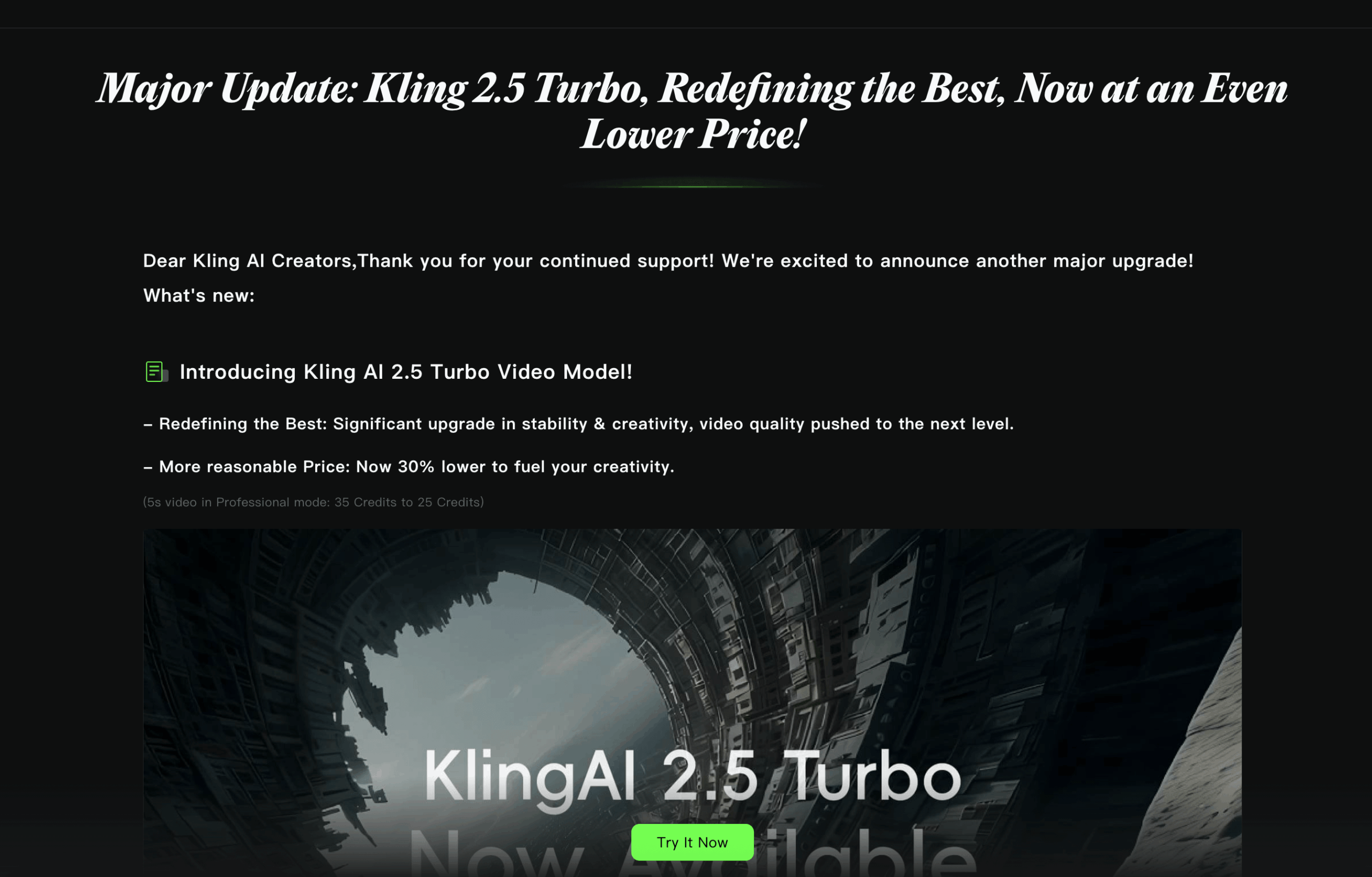
AI Rockstars evaluates Kling 2.5 Turbo: AI video generation reaches Hollywood level at minimal cost by checking official product information, availability, pricing or cost impact, workflow relevance, integration depth, and whether the update changes a practical decision for teams. This article should be read as an AI-news explainer: verify current access, terms, and model behavior before using the tool in production.
What should readers do next?
Use this post to understand the update, then compare it with the broader AI image generation guide and the AI Rockstars planning tools. For business use, check whether the tool improves quality, saves time, reduces cost, or adds integration risk before rolling it into a workflow.
Which official sources should readers compare?
Technical improvements and features
The improved motion prediction algorithms of the 2.5 Turbo version analyze motion patterns and generate more realistic intermediate frames through machine learning models trained on millions of video sequences. This further development is particularly evident in dynamic camera movements, natural character animations and realistic physics simulation for falling objects and fluid dynamics. Benchmark analyses by Curious Refuge Labs rate Kling 2.5 Turbo with an overall score of 7.4/10 points. The detailed score shows: prompt conversion 7.4/10, temporal consistency 6.8/10, visual fidelity 8.1/10 (strongest category), motion quality 7.4/10 and cinematic realism 7.4/10. These performance scores position Kling competitively against established alternatives such as Google Veo 2 and Runway Gen-4.Market positioning and pricing
Read also: Google Lyria: High-fidelity music AI for developers
Kling 2.5 Turbo’s pricing structure significantly undercuts competing products: the Standard plan costs USD 10 per month for 660 credits, the Pro plan costs USD 37 for 3,000 credits and the Premier plan costs USD 92 for 8,000 credits. A five-second video uses 200 credits (about 0.35 USD in the Premier plan), while ten-second videos require 400 credits. This pricing is 3-5x lower than comparable providers with equivalent or superior output quality. The global AI video market demonstrates exceptional growth momentum with a valuation of USD 3.86 billion in 2024 and forecast to grow to USD 42.29 billion by 2033 – representing a compound annual growth rate of 32.2%. North America dominates with 34.8% market share, while Asia-Pacific is the fastest growing region.The most important facts about the update
- Technical basis: Diffusion transformer architecture with proprietary 3D VAE network for synchronous spatio-temporal compression
- Resolution and length: Support for 1080p videos up to 10 seconds in length with multiple aspect ratios (16:9, 9:16, 1:1)
- Improved motion physics: More realistic character animations, smoother camera movements and precise physics simulation
- Benchmark result: Overall score 7.4/10 with visual fidelity as the strongest category (8.1/10)
- Price advantages: 3-5x cheaper than competitor products with comparable quality
- Market volume: AI video market grows from USD 3.86 billion (2024) to a forecast USD 42.29 billion (2033)
- Commercial rights: Full commercial usage rights for all subscription levels without additional restrictions
- Identified limitations: Occasional scene changes, challenges with extremely fast animation and stylistic inconsistencies in anime content
AI Rockstars verdict
TL;DR: Kling 2.5 Turbo is relevant for teams comparing AI video generation models on speed, motion quality, prompt control, and production cost. The real benchmark is whether it can create repeatable shots for a campaign, not just impressive isolated clips.
Editorial recommendation: Use Kling as part of a structured model test. Compare it against alternatives with the same prompts, shot list, brand constraints, and editing workflow before making it a production default.
How to benchmark Kling 2.5 Turbo
| Factor | Priority | Why it matters |
|---|---|---|
| Motion consistency | Critical | Video models must keep subjects, scenes, and camera movement coherent. |
| Prompt controllability | High | Teams need repeatable outputs, not random lucky generations. |
| Speed and cost | High | Production workflows depend on iteration volume. |
| Post-production fit | Medium | Outputs should work with editing, cropping, and campaign formats. |
FAQ
What is Kling 2.5 Turbo used for?
Kling 2.5 Turbo is used for AI video generation, especially when teams need fast iterations and visually strong short clips.
How should marketers test AI video models?
Use identical prompts, fixed evaluation criteria, and real campaign formats instead of judging isolated demo clips.
What matters most for AI video quality?
Motion coherence, prompt control, subject consistency, visual quality, and editing flexibility are usually the key criteria.