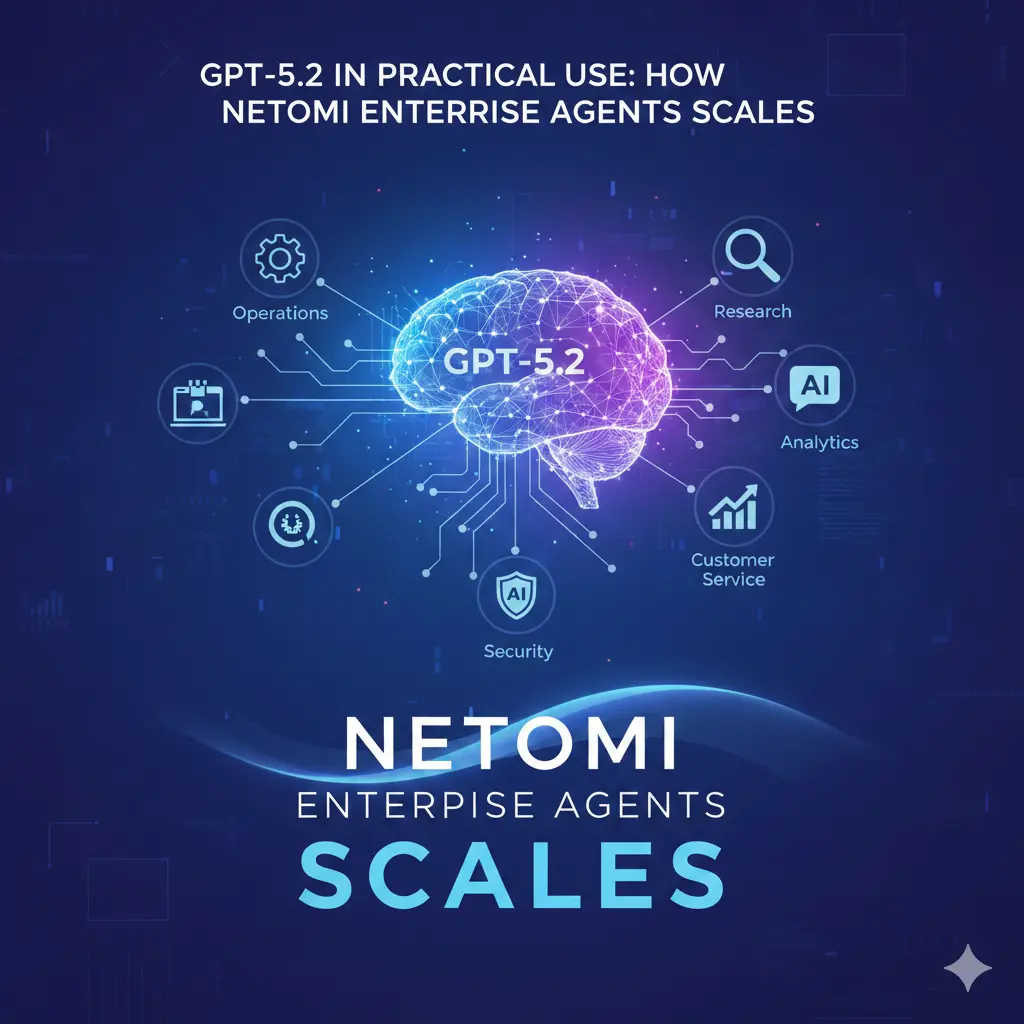
Netomi outlines a blueprint architecture for enterprise agents that replaces static chatbots with autonomous workflows based on GPT-5.2. The system uses an upstream router to handle simple queries via GPT-4.1 and only escalates complex transactions to the more powerful model.
Implement hybrid intelligence
Use a lightweight router model that directs simple traffic (< 600 milliseconds) to the cost-efficient GPT-4.1 and complex reasoning tasks to the powerful GPT-5.2.
Apply ReAct patterns
Force your agent to strictly separate “thought,” “action,” and “observation” via system prompts to minimize hallucinations and process complex business logic atomically.
Specify tool interfaces
Optimize the reliability of function calls with extremely detailed descriptions and strict schema specifications, as modern models such as GPT-5.2 read these definitions instead of guessing.
Establish automated self-correction
Feed API error messages back into the context invisibly as “observation” so that the agent corrects its JSON payload independently without confronting the user with error messages.
Use deterministic guardrails
Validate every AI-generated response against your fixed knowledge base using a downstream layer to reliably block critical factual errors in prices or terms and conditions.
Conceal latency through streaming
Since reasoning models for complex transactions require approximately 3 to 5 seconds of response time, use real-time status updates such as “Checking inventory…” to keep the user experience stable during calculation.
The evolution of enterprise agents: From static bots to autonomous reasoning
For a long time, “chatbot” was synonymous with frustration in the enterprise environment. These systems were based on rigid decision trees: if the user types keyword X, response Y is played. If the customer deviated from the script, the logic collapsed. We are currently experiencing a radical paradigm shift away from these linear scripts toward non-deterministic, generative systems. AI no longer acts as a mere retrieval machine for FAQs, but as a dynamic interpreter of intentions.
Netomi’s approach to “agentic systems” is driving this change. The goal is no longer just conversation, but autonomous execution. Such an agent is deeply integrated into the enterprise architecture—it not only reads data from your Salesforce or Zendesk, it also actively manipulates it.
The decisive leap here is the transition from chat to workflow. Modern enterprise solutions require multi-step reasoning. A simple example illustrates the complexity: A customer asks for a refund. A static bot would simply refer to the return form. An autonomous agent, on the other hand, performs the following steps in the background:
Authentication of the user.
Checking the purchase date against the terms and conditions stored in the knowledge base (e.g., 30-day period).
Calculating the refund amount (minus shipping).
Triggering the transfer in the ERP system.
The architecture of GPT-5.2 is crucial for precisely this type of task chain. While previous models often had difficulty maintaining context stability across multiple logical jumps, the significantly increased number of parameters in GPT-5.2 provides the necessary capacity for disambiguation. The model can accurately translate ambiguous requests (“I want my money back, but I want to keep the goods because they are only slightly damaged”) into technical process steps (partial refund vs. return) without the need for human intervention.
Hybrid intelligence: The orchestration of GPT-4.1 and GPT-5.2 under load
In a real enterprise environment, using a single, monolithic model for all queries is not only inefficient, but also business suicide. Netomi therefore relies on a “hybrid intelligence” architecture, in which an upstream router model acts as a gatekeeper. This router is an extremely lightweight classifier that analyzes each incoming vector in milliseconds and decides: Is this a simple routine task or a complex edge case?
Based on this decision, traffic is dynamically routed. For “high velocity” interactions—i.e., small talk, simple FAQ queries, or greetings—the low-latency and cost-efficient GPT-4.1 takes over. However, as soon as the router detects a “high-value” transaction that requires deep logical understanding or multi-level planning capabilities (reasoning), the call is seamlessly escalated to GPT-5.2.
Here is an overview of the distribution:
Use case
Model selection
Focus
Latency
Greetings & small talk
GPT-4.1
Speed & charm
< 400ms
FAQ & static information
GPT-4.1
Fact reproduction
< 600ms
Complex complaints
GPT-5.2
Reasoning & empathy
~ 2-3s
Database transactions
GPT-5.2
Accuracy & Syntax Compliance
~ 3-5s
The biggest technical hurdle with this approach is context window management. When a user suddenly switches from a simple question (answered by GPT-4.1) to a complex problem (requiring GPT-5.2), the conversation thread must not be broken. Netomi solves this with centralized state handling. The conversation history and extracted entities (e.g., customer number, problem category) are stored in an external memory and injected into the prompt of the new model as structured context each time the model changes. This way, GPT-5.2 immediately knows what GPT-4.1 discussed previously without the user having to repeat themselves.
This strategy maximizes resource efficiency. You don’t “burn” expensive GPT-5.2 tokens for trivial interactions. The system only scales up intelligence when the business case justifies it, massively reducing the average cost per resolved ticket (CPU/token load) without compromising the resolution rate for complex cases.
Deep Dive: Concurrency and Governance in Production Environments
Performance in the lab is one thing, scaling in an enterprise environment is quite another. When you’re serving thousands of customer requests simultaneously, the architecture is put to the test. The biggest technical risk here is concurrency. Since modern agents work asynchronously and often wait for external triggers, thousands of sessions run in parallel. Without clean state management, you risk “race conditions” in your database – for example, when two parallel processes simultaneously attempt to update the same inventory. Robust systems therefore use strict transaction locking and message queues (e.g., Kafka) to ensure that each “thought-action” cycle of the agent is processed atomically and without conflict.
But speed is worthless without correctness. This is where hallucination control comes into play. Even a GPT-5.2 model should never have the final say in an enterprise context without being verified. Netomi relies on deterministic guardrails here. This means that after the LLM has generated a response, it passes through a validation layer that checks facts (such as prices or terms and conditions clauses) against a fixed knowledge base. If the “creative” response contradicts the hard facts, it is blocked or replaced with a standard response.
Another critical aspect for security is role-based access control (RBAC) for AI. An autonomous agent is often technically capable of navigating across all connected systems. However, it must not be allowed to do so. The architecture must ensure that the agent dynamically inherits the permissions of the current user (or service level). A “Level 1” support agent must not have access to admin tools in the backend, even if the LLM theoretically knows how to use them.
Finally, enterprise use requires complete audit trails. In regulated industries, it is not enough to simply store the chat log. You must be able to technically prove why the AI made a decision. The system must therefore log the complete “chain of thought” – i.e., the model’s internal considerations and intermediate steps – as metadata. This is the only way to debug errors in reasoning and meet compliance requirements.
Benchmark and comparison: GPT-5.2 vs. state-of-the-art (GPT-4o / Claude 3.5)
When deciding which model will form the core of your agent architecture, a direct comparison of performance data is essential. Netomi’s experience shows that “newer” does not automatically mean “better” for every task, but when it comes to complex tasks, the playing field shifts significantly.
Reasoning abilities: planning fidelity instead of heuristics
The most critical difference is evident in multi-step processes (multi-step logic). GPT-4o tends to take semantic shortcuts—it guesses the most likely end of a conversation based on patterns. In support scenarios, this often leads to security queries being skipped. GPT-5.2, on the other hand, shows significantly higher consistency in following plans. It is less likely to “forget” intermediate steps, even if the user interrupts the context with small talk. While Claude 3.5 is often brilliant at coding, GPT-5.2 dominates in the stubborn execution of business logic.
Tool Use & API Integration
Agents are useless if they cannot communicate with your backend systems. Here, the reliability of the generated output is crucial.
GPT-4o / GPT-4 Turbo: Usually deliver correct JSON, but tend to make syntax errors with very complex schemas (nested objects) or hallucinate parameters that do not exist in the API document.
GPT-5.2: The error rate for function calling has been drastically reduced. The model checks the payload more rigorously against the definition before making the call. For you, this means fewer retries and fewer aborted transactions in the database.
Nuance and tonality
In the enterprise sector, the “brand voice” is sacred. While earlier models often fell into a generic “AI helpful” tone, GPT-5.2 can be controlled more precisely (steerability). It adheres more strictly to negative constraints (e.g., “Don’t apologize for mistakes made by the user, but offer solutions”), which is particularly important in complaint management to avoid legal liabilities.
Here is an overview of which model is currently suitable for which use case in your architecture:
Model
Ideal use case
Strength
Weakness
GPT-4.1 / GPT-4o-mini
Level 1 support, FAQ, routing
Extremely low response time & costs
Quickly loses context with complex questions
Claude 3.5 Sonnet
Code analysis, document processing
Large context window, very natural-sounding text
Slightly higher latency for tool calls compared to OpenAI
GPT-4o
Standard workflows, email drafting
Good all-rounder, multimodal (image/audio)
Tends to make logical leaps in long chains
GPT-5.2
Complex transactions (refunds), disambiguation
Unsurpassed reasoning & JSON validity
Highest costs and latency (overkill for FAQs)
So don’t choose the model based on hype, but strictly on the complexity of the individual process step.
Blueprint for agent architects: How to implement multi-step workflows
The leap from a simple chatbot to a real assistant is not achieved through magic, but through strict architecture. When designing agent workflows for enterprise scenarios, you need to make the “AI” black box controllable through clear structures. The goal is to replace ambiguity with defined processes.
1. Decomposition of the task
An agent often fails when you give it monolithic tasks such as “Process this complaint.” You need to break down complex business logic into atomic steps that an LLM can process sequentially. A return process does not consist of one step, but of a chain: auth_customer → fetch_order_details → verify_warranty_status → generate_return_label. Each of these steps is a discrete “state” that the agent must successfully complete before moving on to the next one.
2. The “ReAct” prompting approach
Never rely on the model to intuitively do the right thing. Implement the ReAct pattern (Reason Act). Your system prompt must force the model to reveal its thoughts before calling a function. A typical sequence in the log should look like this:
Thought: “The user wants to cancel. I need to check the status of order #123.”
Thought: “The goods have already been shipped. Direct cancellation is not possible. I must suggest the return process.”
This separation prevents the agent from hallucinating that it has performed an action that never took place.
3. Definition of tool interfaces
The quality of your function-calling performance depends 90% on your tool descriptions. GPT-5.2 does not guess; it reads your definitions. If you do not give a tool a clear “scope,” the model will use it incorrectly or not at all.
Here is a comparison between a poor and a good definition:
Feature
Poor definition
Good definition (Agentic standard)
Tool Name
`update_db`
`update_customer_shipping_address`
Description
“Updates the database.”
“Updates the shipping address for a specific order ID. Only valid if order status is ‘pending’ or ‘processing’.”
Parameters
`id`, `data`
`order_id` (string, required), `new_address_object` (JSON, required structure per Schema X)
4. Error handling (self-correction)
In enterprise environments, APIs fail or parameters are missing. A robust agent does not abort in this case. You must implement a self-correction loop. If a tool call returns an error (e.g., Error 400: Missing Date), you must not display this error to the user. Instead, you feed the error message back into the agent’s context as an “observation.”
Modern models such as GPT-5.2 then recognize: “I forgot the date,” correct their own API call, and try again. Only after n failed attempts should an escalation to a human (human-in-the-loop) occur.
Strategic classification: latency, costs, and the limits of autonomy
The implementation of high-end reasoning in the enterprise environment is not purely a technical problem, but primarily a question of unit economics. A “one-size-fits-all” approach that routes every trivial user query through the expensive inference pipeline of GPT-5.2 will inevitably become a cost trap. The token prices for models with advanced reasoning capabilities are significantly higher than for standard models. So you have to calculate critically: Is the massive resource overhead worth it for a simple “forgot password” query? The system only becomes economically viable through strict routing that reserves GPT-5.2 exclusively for highly complex “high value” cases where the business value justifies the inference costs.
This creates a classic trade-off scenario that you need to consider when planning your architecture:
Metric
Standard model (e.g., GPT-4.1)
Reasoning model (GPT-5.2)
Strategic consequence
Costs
Low (suitable for mass production)
Very high
Use only as a last resort for complex logic
Latency
Milliseconds
Seconds (due to chain of thought)
Requires UX management of waiting time
Autonomy
Limited (risk of hallucinations)
High (self-correction)
Use for critical transactions
Latency acts as a potential UX killer here. The complex “chain of thought” (CoT) that GPT-5.2 processes in the background costs valuable computing time. A 5 to 10-second wait feels like an eternity in a chat interface. Streaming interfaces are a must to conceal this. The user must see that the agent is actively working – ideally through transparent status updates (“Checking stock…”, “Validating return policy…”) that are issued during the reasoning process, even before the final answer is generated.
Despite all the power of AI, the need for “human-in-the-loop” remains. There are borderline cases—emotional escalations, sarcasm, or legal gray areas—in which even the best model fails or acts too riskily. Your system must use sentiment analysis or uncertainty scores (confidence thresholds) to recognize when it is time to give up. A seamless handover to a human agent, complete with full context, is not a bug, but an essential feature for enterprise security.
Future outlook: In the next 12 months, we will see a shift in agent architectures. Instead of sending every request to the big cloud giants, finely tuned small language models (SLMs) will take over preprocessing and routine tasks – in some cases even locally (edge AI). GPT-5.2 and its successors will then only act as the “mastermind” for the most difficult 10% of requests. This hybrid architecture is the key to making autonomy scalable and affordable.
Conclusion: AI agents need architecture, not magic
The transition from simple response bots to agents capable of taking action is complete, but Netomi’s lessons clearly show that success on an enterprise scale is less a question of “deep learning” and more a question of “deep engineering.”
It is no longer enough to simply attach the most powerful model to the API. The real art lies in orchestration. Those who unleash GPT-5.2 on every user request are destroying their budget and performance. The future belongs to smart hybrid architectures in which a router decides at lightning speed whether cost efficiency (GPT-4.1) or deep reasoning (GPT-5.2) is required. Your competitive advantage does not come from the model itself – everyone has that – but from how cleanly you integrate state management, concurrency, and guardrails into your existing IT landscape.
💡 Tip: Don’t think of your AI as an all-knowing oracle, but as a motivated junior employee: it needs clear work instructions (prompts), strict permissions (RBAC), and someone to keep an eye on it (guardrails).
🚀 Your action plan for implementation
Instead of getting lost in model selection, start today with this checklist:
Audit your use cases: Analyze your support tickets from the last 3 months. Make a strict distinction between what is “high velocity” (FAQ/status) and what is “high value” (refunds/upselling).
Sharpen your tool definitions: Revise your API descriptions for function calling. Are they precise enough that a human would understand them without asking questions? If not, even GPT-5.2 will fail.
Router first: Build the gatekeeper first. A simple classifier that directs traffic will bring you immediate ROI through cost savings.
Build fail-safe: Implement a self-correction loop. Give the agent the chance to fix JSON errors itself before escalating to a human.
Agentic AI is no longer hype, but a toolkit. Use it to transform operational hustle and bustle into strategic automation – so your team finally has time again for the problems that really require human creativity.
To provide the best experiences, we use technologies like cookies to store and/or access device information. Consenting to these technologies will allow us to process data such as browsing behavior or unique IDs on this site. Not consenting or withdrawing consent, may adversely affect certain features and functions.
Functional
Always active
The technical storage or access is strictly necessary for the legitimate purpose of enabling the use of a specific service explicitly requested by the subscriber or user, or for the sole purpose of carrying out the transmission of a communication over an electronic communications network.
Preferences
The technical storage or access is necessary for the legitimate purpose of storing preferences that are not requested by the subscriber or user.
Statistics
The technical storage or access that is used exclusively for statistical purposes.The technical storage or access that is used exclusively for anonymous statistical purposes. Without a subpoena, voluntary compliance on the part of your Internet Service Provider, or additional records from a third party, information stored or retrieved for this purpose alone cannot usually be used to identify you.
Marketing
The technical storage or access is required to create user profiles to send advertising, or to track the user on a website or across several websites for similar marketing purposes.