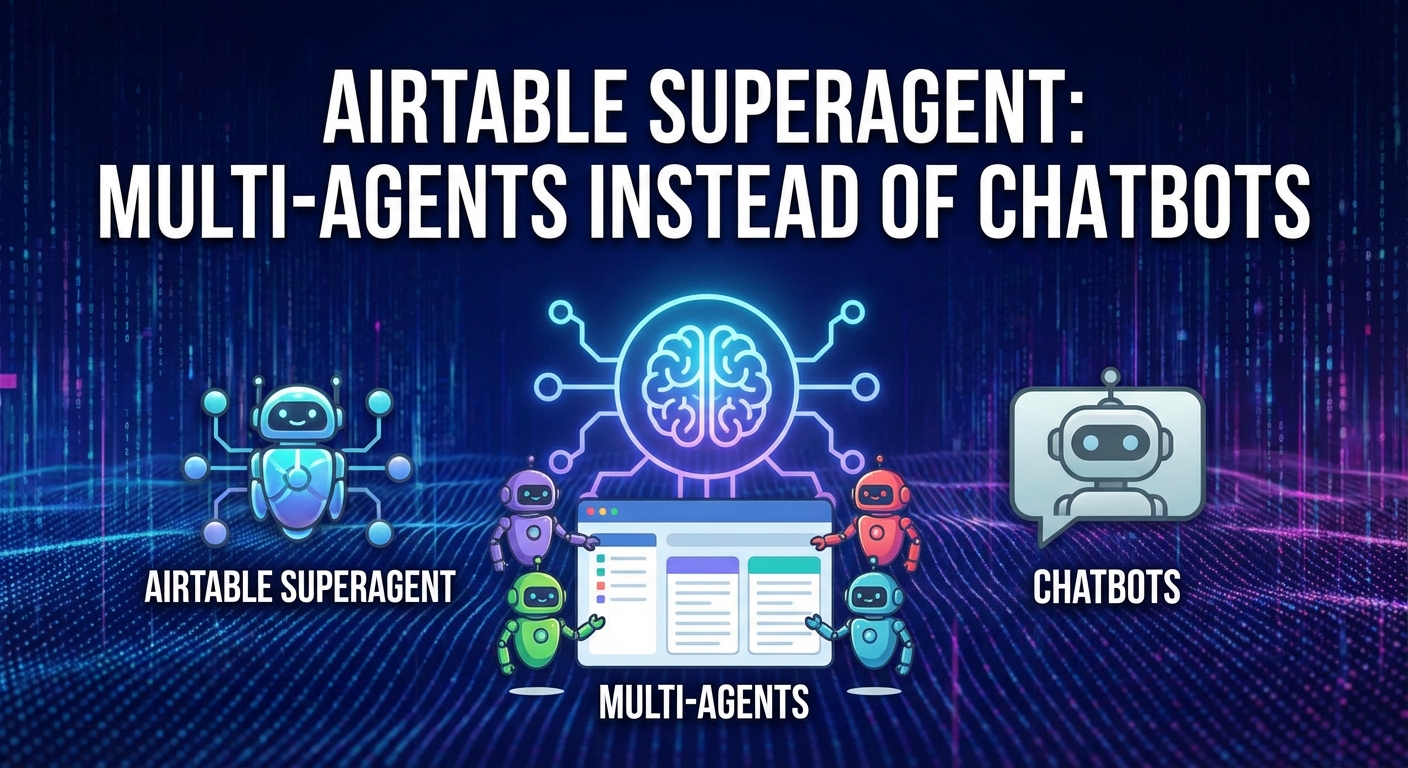
With “Superagent,”Airtable is launching an autonomous AI that not only outlines complex planning tasks but also executes them directly in the database via multi-agent orchestration. The system positions itself as a “headless analyst” that retrieves external sources such as FactSet or SEC filings and provides verified data instead of mere chat responses. We analyze how the technology works and where the aggressive credit pricing model becomes a cost trap for companies.
- Hidden cost multiplier: A single complex user workflow triggers 10 to 15 internal API calls (sub-agents), which means that the credit balance of 15,000–20,000 credits is used up exponentially faster than with simple chats.
- Performance bottleneck: The asynchronous “headless analyst” process leads to a latency of 2 to 5 minutes per result and is limited by a hard limit of 5 requests per second per base.
- Quality assurance via integration: Instead of hallucination-prone web scraping, the agent uses native interfaces to FactSet, Crunchbase, and SEC EDGAR to provide verified source references.
- Structured output: The system does not deliver continuous text, but performs a “verified data writeback” via JSON payload, which maps data (e.g., currencies, URLs) directly to the Airtable fields.
📖 This article is part of our complete AI Agents guide. Read the full guide →
The “Coordinator-Specialist” model: Architecture of the Open-ended Agent Harness
The technical foundation of the Airtable Superagent, unveiled on January 27, 2026, marks a departure from the monolithic LLM approach. Instead of a simple “prompt-response” chain, Airtable uses the “open-ended agent harness” integrated through the acquisition of DeepSky (October 2025).
This architecture solves the main problem of enterprise AI: hallucinations caused by overloading a single model. Instead, the work is divided into specialized agent clusters.
1. The Coordinator: Deconstruction instead of chat
The coordinator agent acts as a project manager. It does not answer questions, but analyzes user input to create a structured “research plan. “
- Prompt decomposition: A request such as “Analyze Tesla’s risk factors compared to the previous year” is not answered directly. The coordinator breaks this down into sub-steps: “Data retrieval 10-K year N,” “Data retrieval 10-K year N-1,” “Semantic comparison,” “Extraction of relevant deltas.”
- Orchestration: It decides which specialized sub-agents are necessary and in what order they must act.
2. The Specialists: Parallel Worker Nodes
Once the plan is in place, the system activates specialized agents that work in parallel (asynchronously). This explains the higher latency compared to ChatGPT, but massively increases the depth of facts.
- Financial Analyst Agent: Uses native integrations with FactSet or Crunchbase to retrieve hard numbers (e.g., “Q3 Net Revenue”).
- Regulatory Scout: Accesses SEC EDGAR databases directly to scan filings.
- Synthesizer: Consolidates the results of the sub-agents before writing them to the database.
This division of labor prevents the creative part of the LLM (which formulates) from corrupting the factual part (which calculates).
3. Verified Writeback: Structure instead of continuous text
The key distinguishing feature of the superagent architecture is (as can be seen in the JSON schema of the developer docs) the output. The system does not deliver a chat block, but performs a “verified data writeback. “
The agent constructs a payload (e.g., action: "updateRecord") that maps data directly to the Airtable architecture:
- Data mapping: A sales value found ends up in a strict
currency field, not in a text field. - Citations: For each data point, a source Source_Link (e.g., deep link to the SEC PDF) is written to a URL field.
- Status tracking: The process is logged in Airtable (e.g., status update from “Planning” to “Analysis Complete”).
Unlike chatbots, which “chat,” this harness acts as a “headless analyst” capable of autonomously sifting through thousands of data records and pressing the results into a relational database structure without the need for human intervention for copy-paste operations.
To understand the positioning of Airtable Superagent in the modern AI stack, you have to move away from the idea of the classic chatbot. Here, we compare three fundamental approaches: no-code operations (Airtable), conversational AI (ChatGPT), and code-first orchestration (LangGraph).
Direct comparison: features & target groups
The following matrix illustrates why Airtable does not attempt to replace ChatGPT, but rather fills a gap in operational data processing.
| Feature | Airtable Superagent | ChatGPT / Claude 3.5 | LangGraph / AutoGen |
|---|---|---|---|
| Primary goal | Structured work(database updates) | Conversation(text generation) | App development(infrastructure) |
| Orchestration | Proprietary “Harness” (no-code multi-agent) | Linear chats / Custom GPTs | Graph-based (requires Python/code) |
| Output | Data sets (rows), charts, status updates | Continuous text, code blocks | APIs, terminal outputs |
| Integrity | High (verified quotes via FactSet/SEC) | Medium (search-based, risk of hallucinations) | Variable (depends on the developer) |
| Users | Ops managers, sales leads | Knowledge workers (general) | AI engineers/developers |
Output logic: “Headless Analyst” vs. Chatbot
The key difference lies in the writeback. While ChatGPT is designed to stream a response into a chat window, the super agent acts as a “headless analyst. “
Users do not necessarily interact with the agent live. Instead, a new entry (e.g., ticker $TSLA in a watchlist) triggers a chain of actions in the background. The output is not a block of text, but a precise update of specific database fields (e.g., Risk_Score_Change as a number field or Source_Link as a URL). The goal is not dialogue, but the completed data record.
Build vs. Buy: The No-Code Limit
For AI engineers, frameworks such as LangGraph or AutoGen remain the gold standard for building (“build”) highly complex, customized agent systems. However, these require maintenance, Python skills, and your own server infrastructure.
Airtable Superagent positions itself as a “buy” solution for operations teams. With the acquisition of DeepSky (October 2025), Airtable integrates an “open-ended agent harness” that makes complex multi-agent orchestration (coordinator-specialist model) available at the click of a button. This allows companies to avoid the technical debt that arises when building agent swarms in-house.
The “integrity gap”: Native sources instead of web browsing
A common problem with LLMs (e.g., via ChatGPT web browsing) is source integrity. The superagent addresses this with Verified Data Writeback.
Instead of scraping the open web, the agent uses specialized interfaces to FactSet (financial data), Crunchbase (private market data), and SEC EDGAR (stock exchange filings).
The result: when the Superagent writes a number in a field, it is not a hallucination from the training data mix, but an extracted data point with a direct link to the source document. This means that the system competes less with an LLM and more directly with the work performance of a human junior analyst.
Here, we are building a pipeline that goes far beyond simple chat interactions. The goal is a system that takes on junior analyst tasks by monitoring SEC databases and writing structured results directly into Airtable.
1. The trigger: Start in the watchlist
The workflow begins passively. We configure an Airtable automation that triggers as soon as a new record is created in the “Watchlist” table (e.g., ticker: $TSLA).
- Trigger: “When record matches conditions.”
- Condition:
Statusis “To Analyze.” - Action: “Run Superagent Script.”
2. Orchestration: The Coordinator Plan
Instead of a simple prompt, we define a multi-step “research plan” in the open-ended agent harness. The coordinator agent breaks down the instruction into discrete steps:
- Retrieve: Load the last two 10-K filings for the ticker via SEC EDGAR integration or FactSet API.
- Compare: Isolate section “Item 1A” (Risk Factors) and perform a semantic comparison (year N vs. N-1).
- Synthesize: Summarize the delta deviations (e.g., “New mention of supply chain risks in Asia”).
3. Execution & Specialist Agents
During execution, the super agent divides the tasks among specialist agents. One agent pulls the raw data via GET /v3/filings, while a second (analytical specialist) calculates the difference. The verified data writeback function is critical here: the agents do not simply hallucinate text, but extract linkable sources.
4. The Writeback: Structured Data Instead of Chat
The unique selling point of the super agent is the return. The system does not deliver a wall of text in the chat window, but a JSON payload that updates specific database fields.
For our risk dashboard, the internal writeback payload looks like this:
{
  "action": "updateRecord",
  "tableId": "tblRiskWatch",
  "recordId": "rec123456789",
  "fields": {
    "Status": "Analysis Complete",
    "Last_Updated": "2026-01-31T14:30:00Z",
    "Risk_Score_Change": 15,
    "Key_New_Risks": "High volatility detected in supply chain section.",
    "FactSet_Source_ID": "filing_8833_sec",
    "Verification_Status": "VERIFIED_BY_SEC_API"
  }
}
5. The result: The “Headless Analyst” dashboard
After a few minutes (the latency is higher than with ChatGPT because real “planning” takes place), the table fills up automatically. The user sees:
- A rich text field with a summary of the new risks.
- A currency field or number field with the calculated
Risk_Score_Change. - A direct source link to the paragraph in the SEC document.
There is no need to manually download PDFs and perform “Ctrl F” searches. This is the shift from “chatbot” to autonomous agent.
Read also: IronClaw: Your secure, local AI agent in Rust
Reality check: The cost trap and technical limits
While the demos are impressive, feedback from early enterprise deployments (including via r/LocalLLaMA and HackerNews) shows that the productive use of the Airtable super agent poses significant hurdles. Those who implement it blindly risk skyrocketing costs and frustrated teams.
The pricing snowball effect
The biggest misunderstanding lies in the consumption model. On paper, 15,000 to 20,000 AI credits per user in the business plan seem generous. In practice, however, a multiplier effect comes into play:
- Multi-agent loops: A single user prompt (“Analyze Q3 finances for these 10 companies”) is not a single API call. The coordinator breaks down the task and fires commands to various specialist agents (e.g., FactSet query plus sentiment analysis).
- Result: A single complex workflow can trigger 10 to 15 sub-calls. The monthly credit balance does not melt away linearly, but exponentially. Users report that budgets are often used up within a few days, which unintentionally forces companies into more expensive enterprise scale tariffs.
Test of patience: latency instead of instant stream
Teams accustomed to the millisecond response times of ChatGPT or Claude experience culture shock with Superagent. Since the process runs asynchronously (“Plan → Assign → Synthesize → Writeback”), users often stare at a “Working…” status for minutes on end.
This is acceptable for in-depth analyses, but for ad hoc queries in sales (“How high was the turnover of prospect X?”), the latency is a dealbreaker. The super agent is not a chatbot, but a slow but thorough background worker.
The bottleneck: 5 requests per second
For developers who build their own harnesses on the Airtable API, the standard rate limit of 5 requests per second (rps) per base remains the most critical bottleneck.
- The reliability trap: When a swarm of agents attempts to write back results in parallel, the API blocks (“rate limit wall”). This leads to incomplete data sets and forces developers to use complex throttling mechanisms.
- Context Ignoring: Despite native integrations, users report the “synthesis trap.” The agent retrieves the correct document (e.g., via FactSet) but hallucinates when summarizing the final value because the context is lost in the transition between agents.
| Metric | Expectation (marketing) | Reality (practice in 2026) |
|---|---|---|
| Credit consumption | 1 prompt = 1 credit | 1 prompt = ~10-15 credits (through sub-agents) |
| Response time | Immediate assistance | 2-5 minutes (asynchronous job) |
| Scaling | Unlimited parallelism | Hard limit at 5 rps (writebacks accumulate) |
| Data output | Perfect analyst | Risk of hallucinations in the synthesis phase |
Recommended: Claude Sonnet 4.6: The massive coding & agent update
Conclusion
The Airtable Superagent marks the long-overdue maturation of enterprise AI: away from endless chatting and toward reliable “doing.” The integration of DeepSky technology impressively demonstrates that Airtable understands what companies really need—not hallucinated poetry, but verified, structured data directly in the fields of a database. The “Coordinator-Specialist” model is technically elegant and bridges the gap between manual hard work and complex Python frameworks.
But where there is light, there is also massive shadow: performance is sluggish, API limits are a bottleneck, and the credit pricing model borders on a cost trap for careless teams.
The decision aid:
- Implement it if: You work in operations or data management and need to automate recurring analysis tasks (e.g., compliance checks, financial research), but don’t have the time or skills to code your own agent swarms via LangGraph. You’re looking for a “headless analyst” who works at night and delivers results in the morning.
- Stay away if: You expect real-time interaction (e.g., support chatbots) or are budget-sensitive. Anyone who thinks they can get a cheap ChatGPT alternative here will be financially overwhelmed by the multiplier effect of the sub-agents. Even hardcore developers who need full control over rate limits will run into walls here.
Next steps:
Don’t treat the super agent like an employee, but like an expensive special tool. Don’t start with a rollout to the entire database. Pick an isolated, value-adding process (e.g., “watchlist analysis of new leads”) and monitor credit consumption microscopically during the first week.
This is where we see the future of no-code: powerful, autonomous, but not for naive “plug-and-play” expectations.