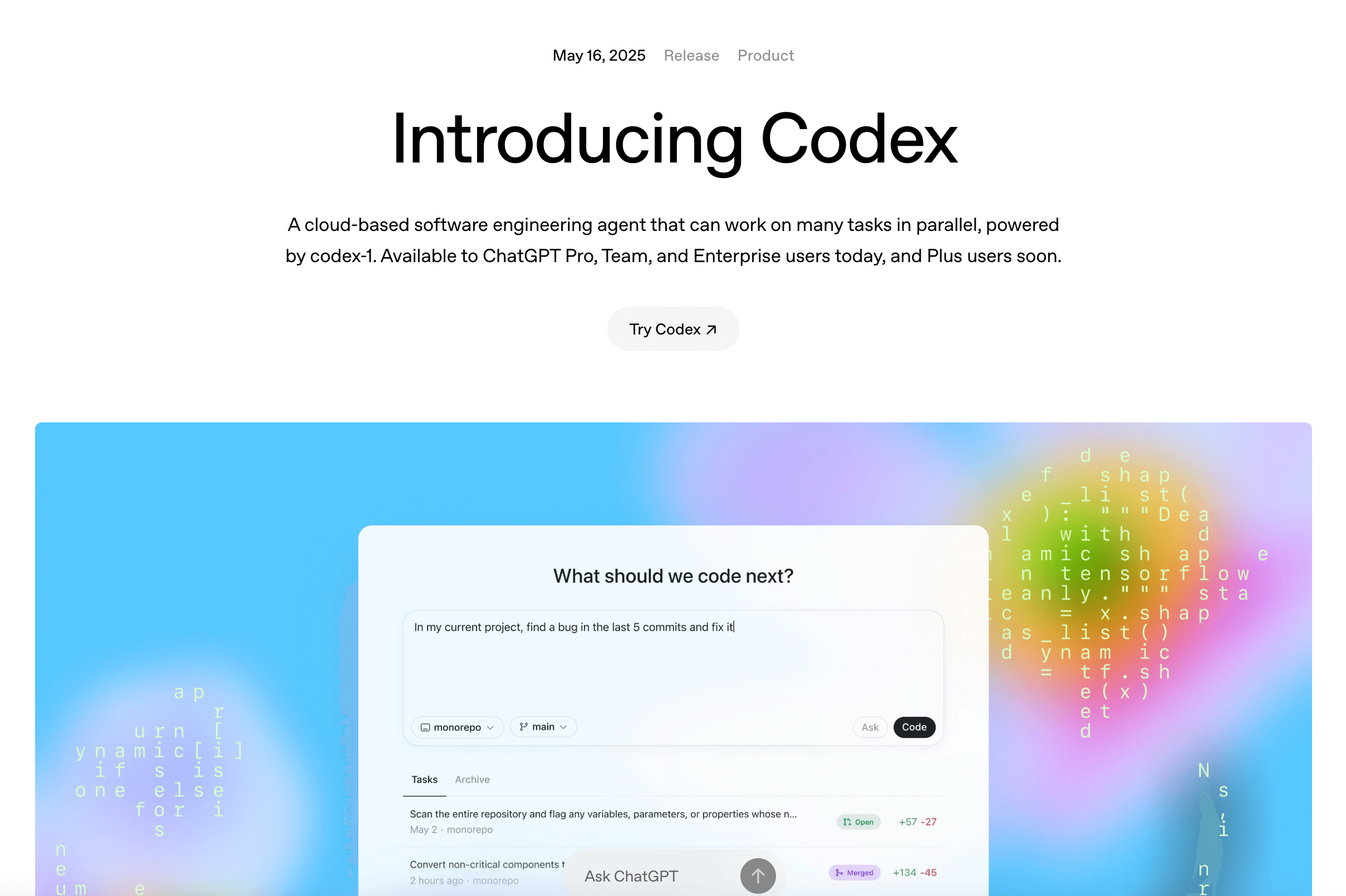
OpenAI Codex: How the AI Coding Agent Fits Into Engineering Workflows
A practical guide to OpenAI Codex: use cases, workflow fit, prompting, security, review discipline, and implementation checklist for engineering teams.
FSFlorian SchröderUpdated Jun 26, 20267 min read Human reviewed
✓ ReviewedLast updated June 26, 2026 by Florian Schröder
BLUF: OpenAI Codex is best understood as an AI coding agent for real software work, not just an autocomplete tool. Its value depends less on impressive demos and more on repository access, clear tasks, tests, review discipline, security boundaries, and how well it fits a team’s development workflow.
TL;DR
Codex is OpenAI’s coding agent for building, editing, reviewing, testing, and shipping software with AI assistance.
It can work across several surfaces, including the Codex app, editor/IDE workflows, terminal/CLI workflows, and ChatGPT-connected environments.
The strongest use cases are scoped implementation tasks, bug fixes, refactors, tests, documentation, code review, and parallel background work.
Teams should treat Codex output like a pull request from a junior-to-mid developer: useful, fast, and reviewable, but not automatically production-ready.
OpenAI Codex is a software engineering agent from OpenAI that helps developers build and ship code with AI. It is designed for tasks such as implementing features, fixing bugs, explaining code, writing tests, preparing pull requests, and working through repository-specific instructions.
OpenAI originally introduced Codex as a cloud-based software engineering agent powered by codex-1, a model variant optimized for coding tasks. OpenAI’s current Codex product page presents Codex more broadly as a coding partner powered by ChatGPT, available across multiple development surfaces.
The practical distinction is important. Classic code assistants usually help inside a line, file, or chat response. Codex is more useful when the task has context: a repository, conventions, tests, dependencies, acceptance criteria, and a review path.
How Codex fits into a development workflow
Codex is strongest when it is given a concrete software task and enough context to verify its work. That makes it useful for background tasks and multi-step changes, but also means teams need process discipline.
Workflow stage
Codex can help with
Human responsibility
Planning
Break down implementation options, inspect code, identify affected files
Decide scope, risk, architecture, and acceptance criteria
The best Codex tasks are specific, testable, and bounded. A vague request such as “improve the app” is too broad. A request such as “add exponential backoff to the notification API, update unit tests, and explain any behavior changes” is much stronger.
Feature implementation
Codex can implement small-to-medium features when the repository has clear patterns and tests. It works best when the prompt names the desired behavior, files or modules to inspect, constraints, and acceptance criteria.
Bug fixing
Bug tasks are a natural fit when the issue can be reproduced with a test or a clear error trace. Codex can inspect related code, propose a fix, run tests, and explain the patch.
Refactoring and migrations
Refactors and migrations can be good candidates when the transformation is repetitive and reviewable. Humans should still define the architectural boundary and watch for behavior changes hidden inside mechanical edits.
Test generation
Codex can add tests for uncovered paths, but generated tests need careful review. A test that mirrors implementation details without checking user-visible behavior can create false confidence.
Code review support
Codex can help identify suspicious changes, missing tests, inconsistent patterns, and likely edge cases. It should supplement human review, not replace it.
Codex vs GitHub Copilot and other coding assistants
Codex overlaps with AI coding assistants, but the useful comparison is not “which tool writes more code.” The better question is where the tool sits in the workflow: autocomplete, chat, repository agent, terminal agent, pull request reviewer, or background worker.
Codex works better when prompts look like engineering tickets, not casual wishes. Give it the problem, expected result, constraints, files to inspect if known, test command, and review format.
Define the task. State the user-visible behavior or technical outcome.
Name constraints. Mention frameworks, style rules, security limits, and files that should not be changed.
Request tests. Tell Codex which test command to run and what new tests should cover.
Ask for a concise summary. Require changed files, behavior changes, and remaining risks.
Review like a PR. Inspect diff, tests, edge cases, dependency changes, and security implications.
AI coding agents can modify real software, so governance matters. Teams should define what repositories Codex can access, which commands it may run, how secrets are protected, who approves changes, and which tasks require human review before merge.
For higher-risk repositories, start with low-impact tasks such as tests, documentation, internal tooling, or small bug fixes. Avoid giving broad autonomy over authentication, payment, infrastructure, data deletion, permissions, or security-sensitive code until review and rollback processes are mature.
Implementation checklist for teams
Requirement
Why it matters
Clear repository instructions
Codex needs conventions, commands, and project-specific rules.
Reliable test suite
Agents need executable feedback, not only natural-language review.
Small task boundaries
Scoped tasks reduce drift and make review faster.
Human approval path
All generated code should pass normal engineering review.
Security boundaries
Secrets, production systems, and sensitive data need strict controls.
Outcome measurement
Track cycle time, review burden, defect rate, and developer satisfaction.
AI Rockstars verdict
OpenAI Codex is most valuable when it is treated as an engineering workflow tool, not a magic code generator. It can shorten implementation loops, reduce context switching, and handle repetitive tasks, but only when teams provide clear instructions, tests, and review discipline.
For most teams, the right starting point is a controlled pilot: choose a small class of tasks, measure time saved, compare defect rates, and decide where Codex reliably improves throughput. For broader AI automation planning, continue with our AI agents guide, prompt engineering guide, and free AI tools.
No. Codex is designed for broader software engineering tasks, including multi-file edits, tests, bug fixes, refactors, pull request preparation, and workflow support across development surfaces.
Can Codex replace software engineers?
No. Codex can accelerate parts of engineering work, but humans still own product judgment, architecture, review, security, and production responsibility.
What tasks should teams try first with Codex?
Good first tasks include test additions, documentation updates, small bug fixes, mechanical refactors, internal tooling, and clearly scoped feature changes with reliable tests.
What makes Codex output trustworthy?
Trust comes from reviewable diffs, passing tests, clear summaries, traceable commands, small scope, and human approval. Generated code should go through the same review path as human-written code.
Florian Schröder is a co-founder of AI Rockstars and an expert in AI strategies for marketing. He advises companies on integrating AI tools such as ChatGPT, Claude, and Gemini into their workflows. With over 10 years of experience in digital marketing, he combines technical expertise with practical applications.
To provide the best experiences, we use technologies like cookies to store and/or access device information. Consenting to these technologies will allow us to process data such as browsing behavior or unique IDs on this site. Not consenting or withdrawing consent, may adversely affect certain features and functions.
Functional
Always active
The technical storage or access is strictly necessary for the legitimate purpose of enabling the use of a specific service explicitly requested by the subscriber or user, or for the sole purpose of carrying out the transmission of a communication over an electronic communications network.
Preferences
The technical storage or access is necessary for the legitimate purpose of storing preferences that are not requested by the subscriber or user.
Statistics
The technical storage or access that is used exclusively for statistical purposes.The technical storage or access that is used exclusively for anonymous statistical purposes. Without a subpoena, voluntary compliance on the part of your Internet Service Provider, or additional records from a third party, information stored or retrieved for this purpose alone cannot usually be used to identify you.
Marketing
The technical storage or access is required to create user profiles to send advertising, or to track the user on a website or across several websites for similar marketing purposes.